


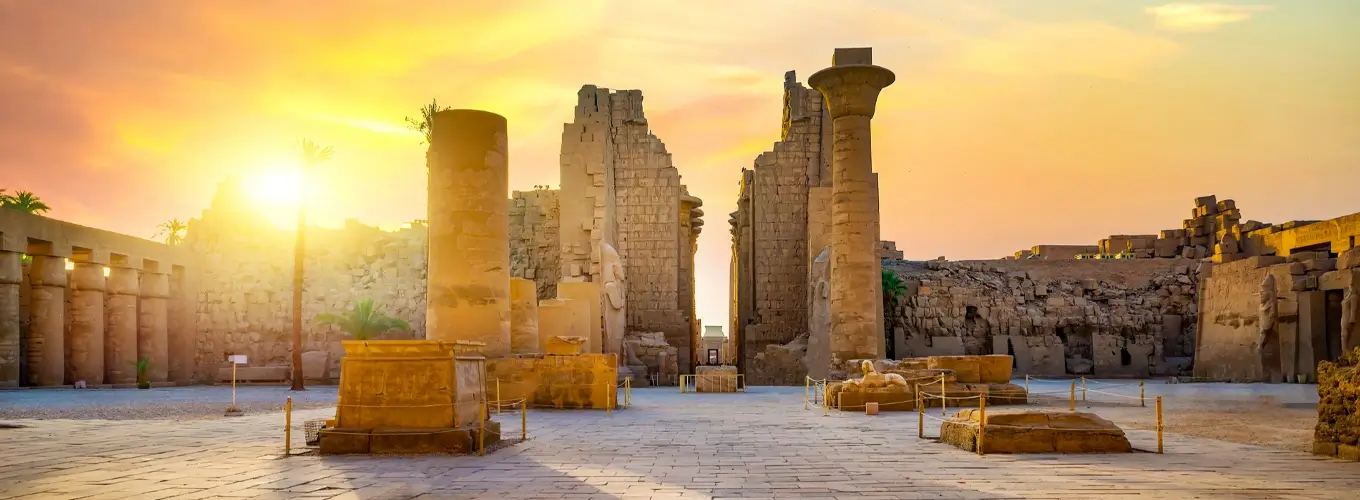
Karnak Temple is the world’s largest religious complex, covering over 200 acres on the East Bank of the Nile in Luxor, Egypt. Built over roughly 2,000 years by more than 30 pharaohs, it is dedicated to the god Amun-Ra and the Theban Triad. Key highlights include the Great Hypostyle Hall, Sacred Lake, towering obelisks, and the Avenue of Ram-Headed Sphinxes. Entrance costs EGP 600 for adults (approximately $12 USD).
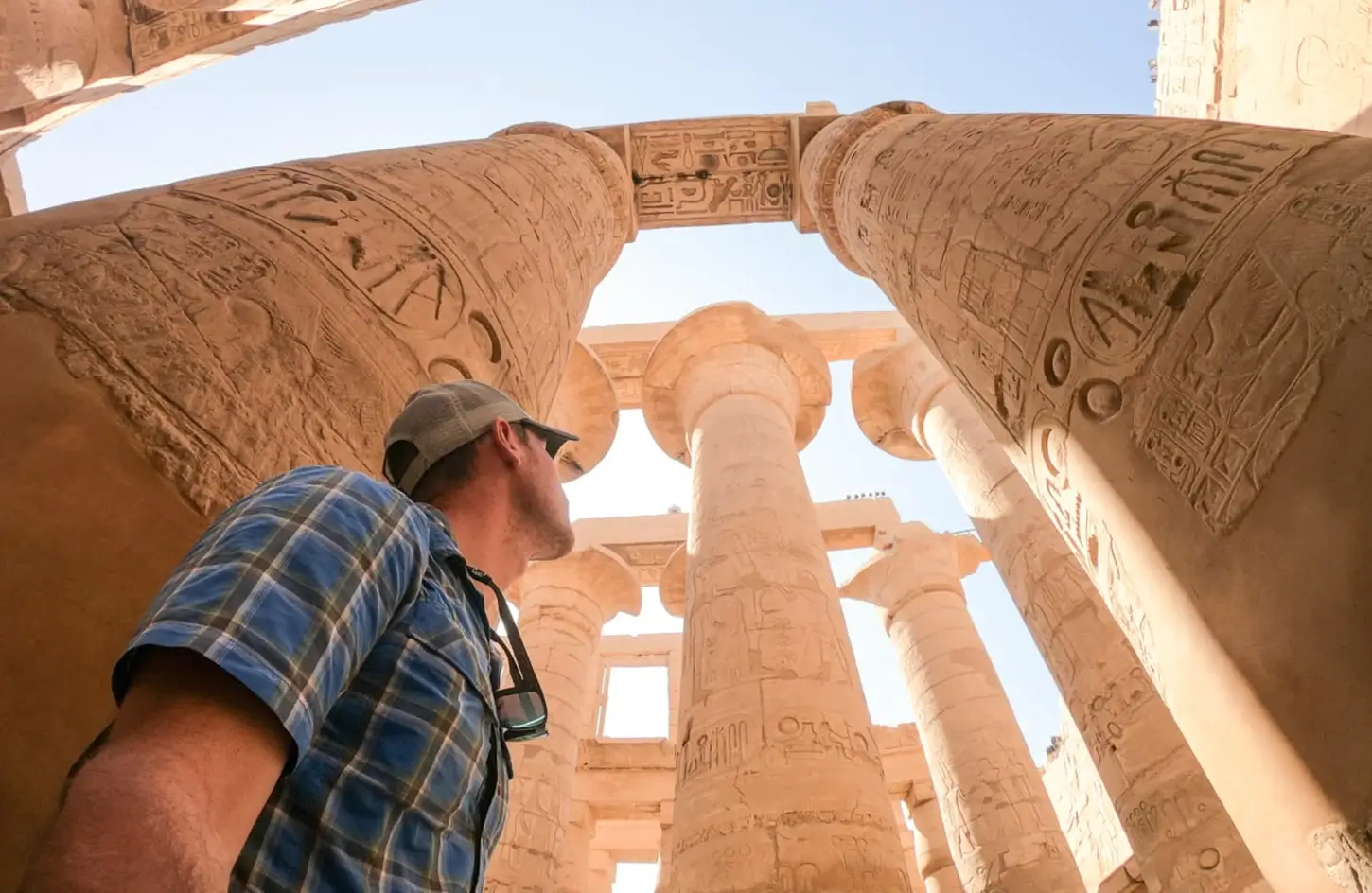
The feeling is always the same after taking visitors to Karnak Temple: a sense of silence. This isn’t uncomfortable silence – this is the silence that descends when one is in the presence of something that is just too big and too old to put into words straightaway. I can stand before the facade of the Great Hypostyle Hall many times in my life, but I will still be standing there with my neck craned upwards, trying to take in columns soaring up to nearly 24 meters in height, all covered in hieroglyphics and painted reliefs that could occupy hours of study on one wall alone.
It’s this quality that draws travelers seeking more than sightseeing — for a guided meditation experience inside Karnak’s Great Hypostyle Hall, see our Egypt Spiritual Tours.
Karnak is not Egypt’s prettiest temple; for that, you can either side with Philae or Abu Simbel, but it is definitely Egypt’s most impressive, complex, and in many ways, most significant temple. To know Karnak is to know three millennia of Egypt’s ambitions in religion and politics, all compacted into one place. From history and highlights to how to see it, what most visitors overlook, and finally, what I share with my clients before they even come here.
What Is Karnak Temple?
Karnak Temple is not one temple. Rather, it is a huge temple complex comprising various temples, chapels, pylons, obelisks, sacred lakes, processional ways, and open-air museums, constructed over almost 2,000 years. Situated on the East Bank of the River Nile in Luxor – Thebes in ancient Egypt, the temple covers more than 200 acres and served as the spiritual and administrative center of Egypt during the New Kingdom (1550-1070 BC).
The name of the temple in the ancient Egyptian language is Ipet-Isut, which translates to “The Most Selected of Places,” and there is nothing exaggerated about it. Karnak temple became the wealthiest temple in Egypt when it held vast properties, thousands of priests, and gifts from various pharaohs who sought to inscribe their names on its walls.
A Brief History of Karnak Temple
From the Middle Kingdom to the New Kingdom
The construction work at Karnak dates back to about 2055 BC, during the Middle Kingdom, when the first structures were erected to honor Amun, who was then only a local god. This oldest structure is hidden beneath other temples, but archaeologists know it exists. During the 12th dynasty, the first major building was erected, but today’s structure dates mostly to the New Kingdom era, when Thebes had become the capital of Egypt and Amun-Ra was considered the supreme god of the land.
The growth of Karnak during the New Kingdom era was entirely political. All pharaohs wanting to establish themselves as legitimate, pious, and powerful would add something here, whether that was a pylon, a courtyard, an obelisk, or a chapel. Karnak was a concrete representation of all of Egypt’s royal ambitions, adding layer upon layer of architecture to the site, which is why visiting feels less like exploring a temple and more like reading an autobiography written in stone by an entire civilization 2,000 years ago.
The Pharaohs Who Built Karnak
More than 30 pharaohs left their mark on Karnak, but several stand above the rest.
- The first monument at Karnak was created by Senusret I, who lived between 1971 BC. This monument, known as the White Chapel, has been reconstructed at the Open Air Museum. This is one of the most sophisticated architectural monuments of the Middle Kingdom, but most tourists miss it.
- Two of the best-known obelisks at Karnak were constructed by Hatshepsut, who lived from 1473 BC to 1458 BC. One of these obelisks is the tallest surviving ancient Egyptian obelisk, measuring 29.5 meters. She constructed the Red Chapel, which was designed as a chapel for Amun’s bark. However, most images of Hatshepsut were destroyed by her successor, Thutmose III.
- Thutmose III himself is among the most productive builders in Karnak, and he is behind the building of the Festival Hall (Akh-Menu). This hall boasts interesting architecture, with a unique style of columns called tent-pole columns, which resemble the tents that could be erected during military campaigns.
- The Great Hypostyle Hall was jointly constructed by Seti I and Ramesses II (19th Dynasty). The Great Hypostyle Hall is the most popular site in Karnak, perhaps one of the best constructions in the ancient world.
- Ramesses III constructed a small but well-preserved temple at the entrance court and had military battles carved in beautiful reliefs.
- The First Pylon, along with its enclosure walls, was constructed by Nectanebo I (30th Dynasty). This is the final construction at Karnak, and it was never completed. At the time work stopped, even the ramps used to build the stones were left standing.
Karnak After the Pharaohs
The religious center remained operational even after the Ptolemaic and early Roman periods, during which the Ptolemaic and early Roman rulers erected buildings in the Egyptian style. However, by the fourth century CE, as Christianity rose in popularity in Egypt, the complex fell out of use. Houses of mudbrick began to appear among the ruins; stones were removed from the pylon and used elsewhere in construction, while earth covered entire sectors of the temple complex. It was only during the nineteenth century, with the French and Egyptian archaeology teams, that the Karnak temples were rediscovered.
The Three Precincts of Karnak
Most visitors see only one part of Karnak, but the complex is divided into three main precincts, separated by massive mudbrick enclosure walls.
The Precinct of Amun-Re
This is the major complex – the place where everyone comes, featuring the Hypostyle Hall, the obelisks, the Sacred Lake, and the Open Air Museum. This complex is undoubtedly the largest of the three and contains the core of all the information provided in this guide. Spend at least three hours, preferably five.
The Precinct of Mut
The Precinct of Mut is found to the south of the Amun-Re Complex and honors the wife of Amun, the goddess Mut. This is made up of a number of temples, along with its own sacred lake, which is crescent-shaped and called “Isheru,” though it may be difficult to access, as it is sometimes closed to the public. The Precinct of Mut is well worth the trouble if one can gain entry, because it is much quieter than the other complex.
The Precinct of Montu
Of the three precincts, the Precinct of Montu is the smallest and least visited one and is located to the north of the Precinct of Amun-Re, and it worships Montu, the god of war with a falcon’s head, who is said to be the original god worshipped in Thebes until the emergence of Amun.
What to See at Karnak Temple: A Section-by-Section Guide
The Avenue of Ram-Headed Sphinxes
This experience actually starts even before reaching the temple complex. The processional way leading towards the First Pylon is lined with ram-headed sphinxes called the Criosphinx, each holding in its fore paws a miniature figure of Ramesses II. In the past, more than 1,000 such statues graced the 2.7-kilometer road connecting the Karnak and Luxor Temples.
Recently reopened to visitors, this was considered the holy way through which statues of Amun, Mut, and Khonsu were carried in procession during the Opet Festival.
The First Pylon and Great Court
The First Pylon is the gigantic entrance one passes through upon reaching the temple. It was constructed during the 30th dynasty by King Nectanebo I, but it was never fully completed; remnants of the mudbrick ramps used in its construction are still visible within it.
The First Pylon is the largest pylon in Egypt, measuring about 113 meters wide and 43 meters tall. Beyond the First Pylon is the Great Court, which contains the Temple of Seti II, the perfectly preserved Temple of Ramesses III, and a single pillar from a kiosk of King Taharqa.
The Great Hypostyle Hall
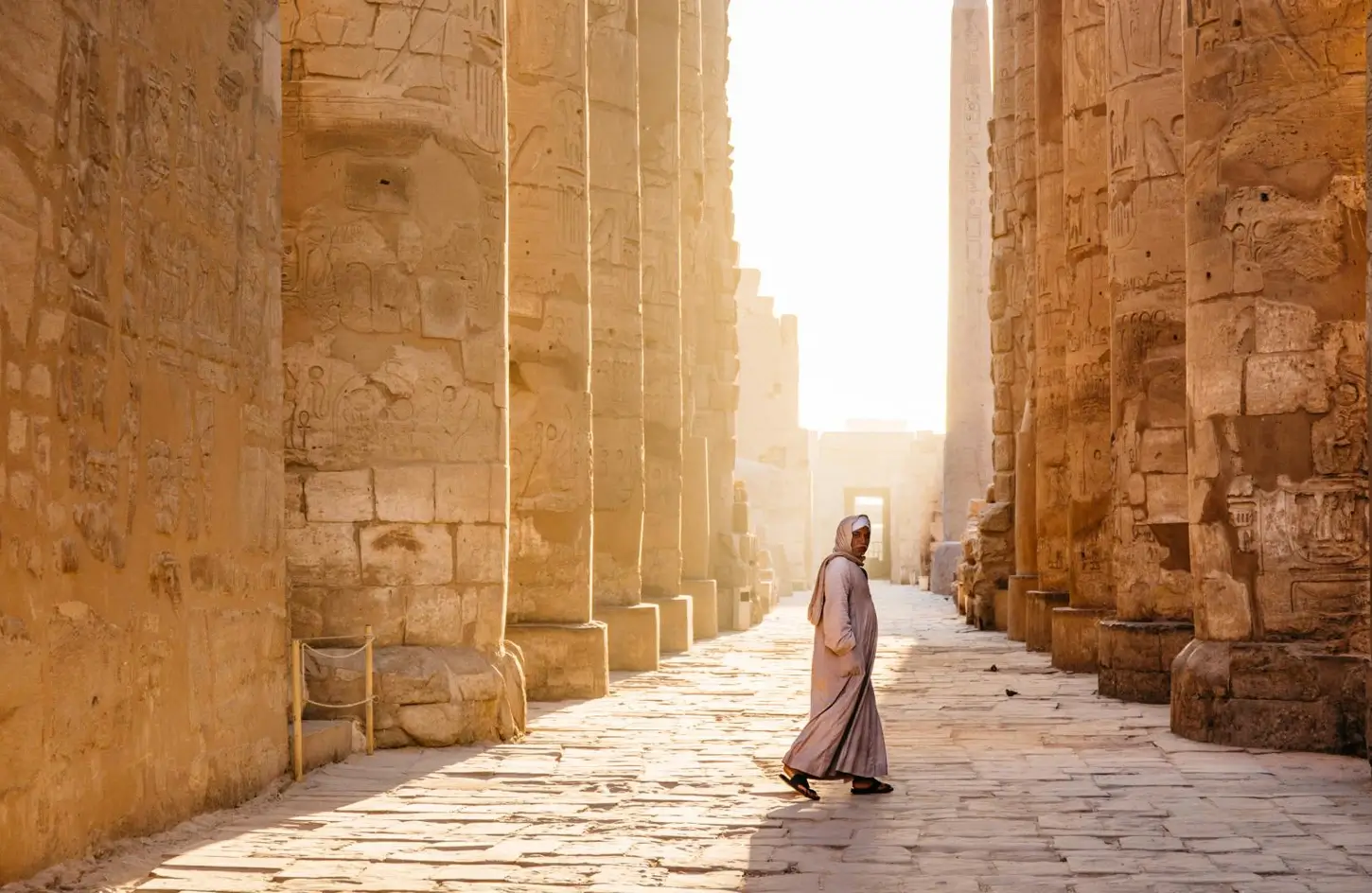
It is safe to say that this place is the centerpiece of Karnak Temple. The hall measures 5,000 square meters and has 134 colossal sandstone columns, with the two middle columns standing 24 meters high and so large that six grown men with arms extended cannot embrace their bases. The hall was built by Seti I but finished by Ramesses II.
It is evident where one stops, and the other begins, since Seti I’s northern part exhibits more detailed sunken relief while Ramesses II’s southern part showcases bold raised relief. Remnants of the original blue, red, and yellow colorings can still be seen on some columns.
The Obelisks of Hatshepsut and Thutmose I
Two of the most famous obelisks of Karnak are located between the fourth and fifth pylons. The Obelisk of Hatshepsut is 29.5 meters high, made of a single block of pink granite from Aswan, and is the largest obelisk in Egypt. Its tip was covered with electrum meant to reflect sunlight onto its top at sunrise. It was not damaged by Thutmose III, as it was too sacred, yet it was hidden behind mudbrick walls.
The Sacred Lake
The sacred lake of Karnak is the largest in any Egyptian temple, measuring about 120 by 77 meters, fed by water from the Nile’s underground, and priests used the lake for their purification rituals. Near the northwest end of the lake, there is a granite scarab of Khepri set up by Amenhotep III.
According to local belief, walking seven times anticlockwise around the lake helps fulfill wishes. I advise my clients to take part in the process regardless of this fact.
The Karnak Open Air Museum
This is something many visitors overlook, which is a real pity. Right next to the First Pylon, on your right as you go in, is the Open Air Museum, which features reconstructed chapels and pieces found within the interior of later pylons that had been reused as infill.
The best thing about it is the White Chapel of Senusret I (circa 1950 BC), one of the earliest and most exquisite buildings ever erected at Karnak, with an elegance not seen anywhere else nearby. Don’t forget the Red Chapel of Hatshepsut and the Alabaster Chapel of Amenhotep I. Admission is free with your ticket. 45 minutes extra.
The Karnak Sound and Light Show: Is It Worth It?
The short answer: yes, with reasonable expectations.
The show is held each night for around 75 minutes – a guided tour of the temple site at night, with narration and music, concluding with a seated show by the Sacred Lake. The ambiance at night is really impressive, and the reflection on the lake during the sitting finale is the visual high point. The narration is entertaining rather than informative, but it provides all the essential background.
- Performance timings: 7:00 pm (in English) and 8:00 pm (multiple languages), on a daily basis. Timings may vary according to the season.
- Languages: English, French, German, Italian, Spanish, Arabic, and many more.
- Price of ticket: Approximately EGP 200-250 per individual for the performance only. Package tour costs range from $35 to $65 USD, including hotel pickup.
In all honesty, my advice to first-time visitors is to ensure they attend a daytime show. When visiting Luxor for two or more days, I would recommend that both be attended because they work well together. There isn’t any added value in terms of history; it’s the experience that counts.
Karnak Temple vs Luxor Temple: What’s the Difference?
Visitors frequently ask whether to visit Karnak, Luxor Temple, or both. The answer is both, but they are very different experiences and should be treated as such.
| Karnak Temple | Luxor Temple | |
|---|---|---|
| Scale | 200+ acres — overwhelming | Compact — more manageable |
| Age | Built from 2055 BC onward | Built primarily from 1400 BC |
| Dedication | Amun-Ra (primary daily cult temple) | Opet Festival (celebration and renewal) |
| Character | Complex, layered, many structures | Single coherent processional temple |
| Best time to visit | Morning or early afternoon | Sunset and evening |
| Crowds | Significant during peak hours | Lighter than Karnak |
| Complexity | Requires a guide or preparation | Easier to navigate independently |
| Distance apart | 3 km south of Karnak | 3 km north of Luxor Temple |
In the olden days, Amun-Ra lived in Karnak and was worshiped here each day. During the Opet Festival, Amun-Ra traveled to Luxor Temple for his annual visitation of rebirth in a spectacular festival of the gods’ processions through the Avenue of Sphinxes from one temple to the other. Recognizing their connection helps us see the two temples not just as separate monuments, but as components of one sacred landscape.
How to Visit Karnak Temple: Practical Information
Tickets and Opening Hours
Standard entrance ticket:
- Foreign adults: EGP 600 (approximately $12 USD)
- Foreign students (with a valid ID): EGP 300 (approximately $6 USD)
- Egyptian adults: EGP 40
- Egyptian students: EGP 20
- Children under 6: free
Open Air Museum: Included in the standard ticket.
Opening hours:
- Summer (approximately April–September): 6:00 AM – 6:30 PM
- Winter (approximately October–March): 6:00 AM – 5:30 PM
⚠️ Important payment note: As of 2026, cash is no longer accepted at Karnak Temple or most major Egyptian archaeological sites. Tickets must be paid by credit or debit card.
Getting There
Karnak Temple sits on Luxor’s East Bank, approximately 3 kilometers north of the city center. Getting there is straightforward:
- Taxi: This is the best choice. Make sure that you have agreed upon the fare before getting into the taxi, or take Uber if available. Budget EGP 30 to 60 from central Luxor.
- Horse-drawn carriage (calèche): A very old-fashioned and picturesque way of going there by the river Nile Corniche. It is good to choose this means for the return journey. Be sure you negotiate the cost before starting the ride.
- Walking or cycling: Both ways are possible from central Luxor along the Corniche. Walking takes about 30-40 minutes. You can also rent a bicycle from any hotel for EGP 50-100 a day.
- Organized tour: In case you are coming to Karnak from Hurghada, Cairo, or a Nile cruise, all the details will be arranged by your tour operator. Day trips from Hurghada leave early in the morning – 4:00 am-5:00 am.
How Long to Spend at Karnak
This is the question I am asked most often, and most guides underestimate it.
- Highlights (hypostyle hall, Sacred Lake, obelisks): 2–2.5 hours
- A complete tour (including all main attractions and Open Air Museum): 4–5 hours
- A thorough tour (including all precincts): a whole day
If you have just one day to spend in Luxor, do Karnak in the morning (from 6:00 AM to noon), take a rest from the heat at noon, and continue visiting the West Bank and Luxor Temple in the evening. 90 minutes will definitely not be enough to satisfy your thirst for knowledge.
Best Time to Visit Karnak
Optimum months: October to April. The daytime weather is pleasantly warm (18° – 28°C). Evenings are nice, and the light at dawn is spectacular. It is also the tourist season, so it is best to arrange accommodation and guided tours in advance.
The best time of the day: Arrive when the temple opens – 6:00 AM. It is not hot, the light is soft, and for the first hour or so, you can enjoy some areas of the temple all alone. Bus tours usually depart around 9:00 – 10:00 AM.
Summer (May to September): Temperatures in Luxor often exceed 40 °C. If you plan to come during the summertime, try going out at 6:00 AM, finish everything by 10:00 AM, and then come back only late in the afternoon. Have much more water with you than you expect to have.
An amazing thing to experience: Every year on the 21st of December — the shortest day of the year — the rising sun becomes perfectly aligned with the east-west axis of Karnak and illuminates the inner sanctuary at dawn. It was no accident; it demonstrates the ancient Egyptians’ knowledge of astronomical cycles and their deliberate use in temple construction. If your schedule allows, this is an amazing sight at any ancient site in the world.
Nada’s Pro Tips for Visiting Karnak
- Arrive by 6:00 AM. The first hour — golden sunlight, cool weather, no crowds — offers a completely different atmosphere from the crowded morning hours. One tip alone will make all the difference.
- Bring an Egyptologist, not just a tour guide. Karnak on its own is amazing, but with the guidance of an Egyptologist, it becomes incredible. Always ask for a licensed Egyptologist through the Ministry of Tourism — this comes as standard with all Karnak tours through Tripianto.
- Get the guidebook from the entrance (approximately EGP 50). Vital for anyone visiting independently — this contains a map and description of the major areas.
- Do not be satisfied with visiting the Hypostyle Hall. This is where many tours end, but it is more of a midpoint than an endpoint. There is very little congestion beyond this point in the Inner Sanctuaries, the Festival Hall of Thutmose III, and near the fourth and fifth pylons.
- When you exit the Hypostyle Hall, turn left towards the Open Air Museum. Many tourists turn right and skip the whole thing. The White Chapel of Senusret I alone justifies the visit.
- Bring sensible footwear. The entire Karnak Temple Complex is comprised of rocky terrain and loose gravel.
- Keep at least two liters of water with you (three in summer). There are some vendors within the compound, but not everywhere within the premises.
- For the sound-and-light show, make sure to reserve a seat for the English show at 7:00 PM and arrive 20 minutes early. It will be cold at night in Luxor after sunset; hence, wear a sweater.
- Regarding souvenir vendors: Bargaining for 30-50% off is possible.
Frequently Asked Questions About Karnak Temple
Why is the Temple of Karnak so famous?
The importance of Karnak can be gauged by the fact that it was the largest religious complex ever built. With an area of over 200 acres and more than 30 Pharaohs contributing to it over 2,000 years, it certainly holds a very special place in history. The Great Hypostyle Hall in Karnak, with 134 gigantic columns spanning 5,000 sq m, is indeed one of the most magnificent architectural structures known to mankind.
Who is the god of Karnak?
Karnak was primarily intended for the worship of Amun-Ra, the highest state deity in ancient Egypt during the New Kingdom. Besides Amun-Ra, Karnak also worships his consort Mut and his offspring Khonsu, thereby forming the Theban Triad. The smaller shrines at Karnak pay homage to other gods such as Ptah and Montu.
Is Karnak the biggest temple in the world?
Indeed, Karnak holds the record as the largest religious structure built in the ancient world, with a sprawling area of over 200 acres. Just to give you an idea, the Notre Dame Cathedral in Paris can fit within the Great Hypostyle Hall of Karnak.
Are Karnak and Luxor Temple the same?
No, they are two separate temples. Karnak was the primary temple used for the daily worship of Amun-Ra and was large and complex in its construction. Luxor Temple is a smaller, more private temple used only for the Opet festival, during which the statue of the god would be transported from Karnak through the avenue of sphinxes.
How far is Karnak from Luxor Temple?
The Karnak and Luxor Temples are about 3 kilometers apart and can be connected by the Avenue of the Sphinxes, which was recently refurbished. It takes only 10 minutes to travel between them by taxi, while walking takes about 30–40 minutes.
What is the oldest temple in Egypt?
The Temple of Satet on Elephantine Island in Aswan includes relics dating to about 3200 BC, making it one of the oldest religious buildings in Egypt. The White Chapel of Senusret I (about 1950 BC), located inside the Karnak Temple Complex, is considered one of the oldest existing buildings there. Thus, the history of temples in Egypt spans more than 3,000 years, so “oldest” is relative here.
What is the most beautiful temple in Egypt?
This is definitely a matter of opinion, but to Egyptologists and tourists alike, Philae Temple in Aswan is undoubtedly one of the most beautiful sites, with its island location, perfectly preserved Ptolemaic carvings, and romantic ambiance that contrasts greatly with the majestic architecture of Karnak. The most impressive site is definitely Abu Simbel, while the most overwhelming is Karnak. Luxor Temple at night is the most atmospheric. Fortunately for us, Egypt doesn’t force us to pick just one site.
Final Note from Nada Safwat
Each time I reach Karnak, I try to remind myself of how it felt when I arrived the first time – the sight of the First Pylon, the Hypostyle Hall up ahead, with columns towering so tall that your head has no choice but to crane. But what really inspires awe in me is not its grandeur but rather its history: thirty pharaohs over 2,000 years, all leaving their mark at a place they believed to be the holiest in the world. They erected things with such gravity and durability that nothing we construct today can compete with them.
My suggestion is simple – allow yourself ample time in Karnak. Arrive early, move slowly, and do not rush. Karnak appreciates those who pause.
If you would like help planning your visit — a private, guided Luxor day tour or a full Egypt itinerary — we at Tripianto are here to help. We design tailored experiences for travellers who want to see Egypt properly, with the right guide, the right pace, and the right context for every site.
