


published: June 2026
Quick Answer
❓ What is Luxor Temple & is it worth visiting?
Luxor Temple is a 3,400-year-old pharaonic sanctuary built c. 1400 BC by Amenhotep III on the Nile’s east bank — dedicated to Amun and the renewal of royal power during the annual Opet Festival.
🏛️ Built around 1400 BC by Amenhotep III
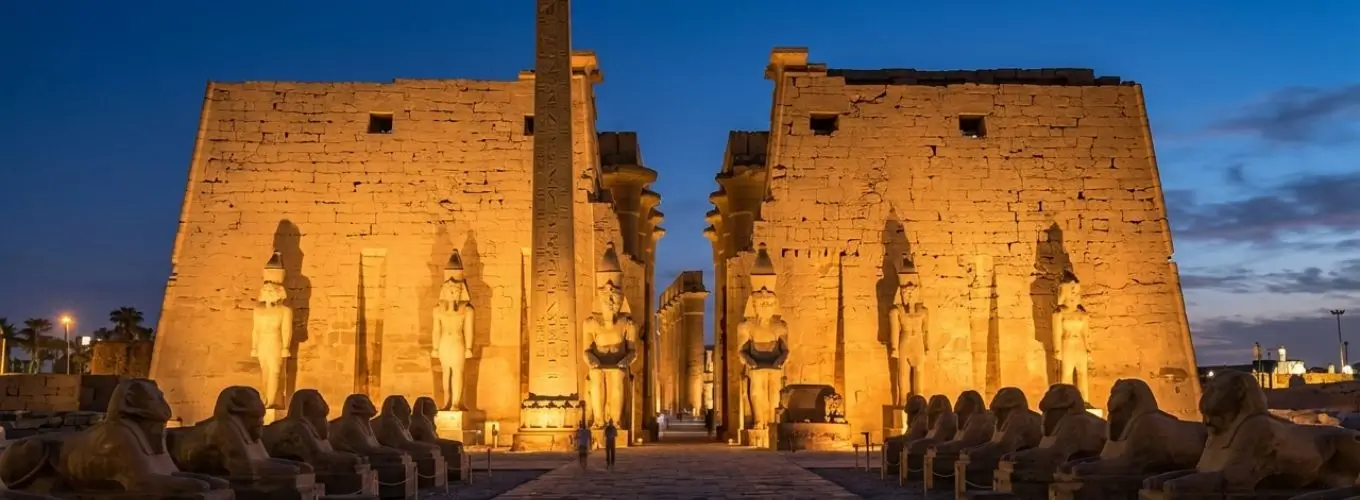
later expanded by Ramesses II, who added the massive entrance pylon, twin obelisks & colossal seated statues still standing today.
🌙 Visit at sunset or after dark
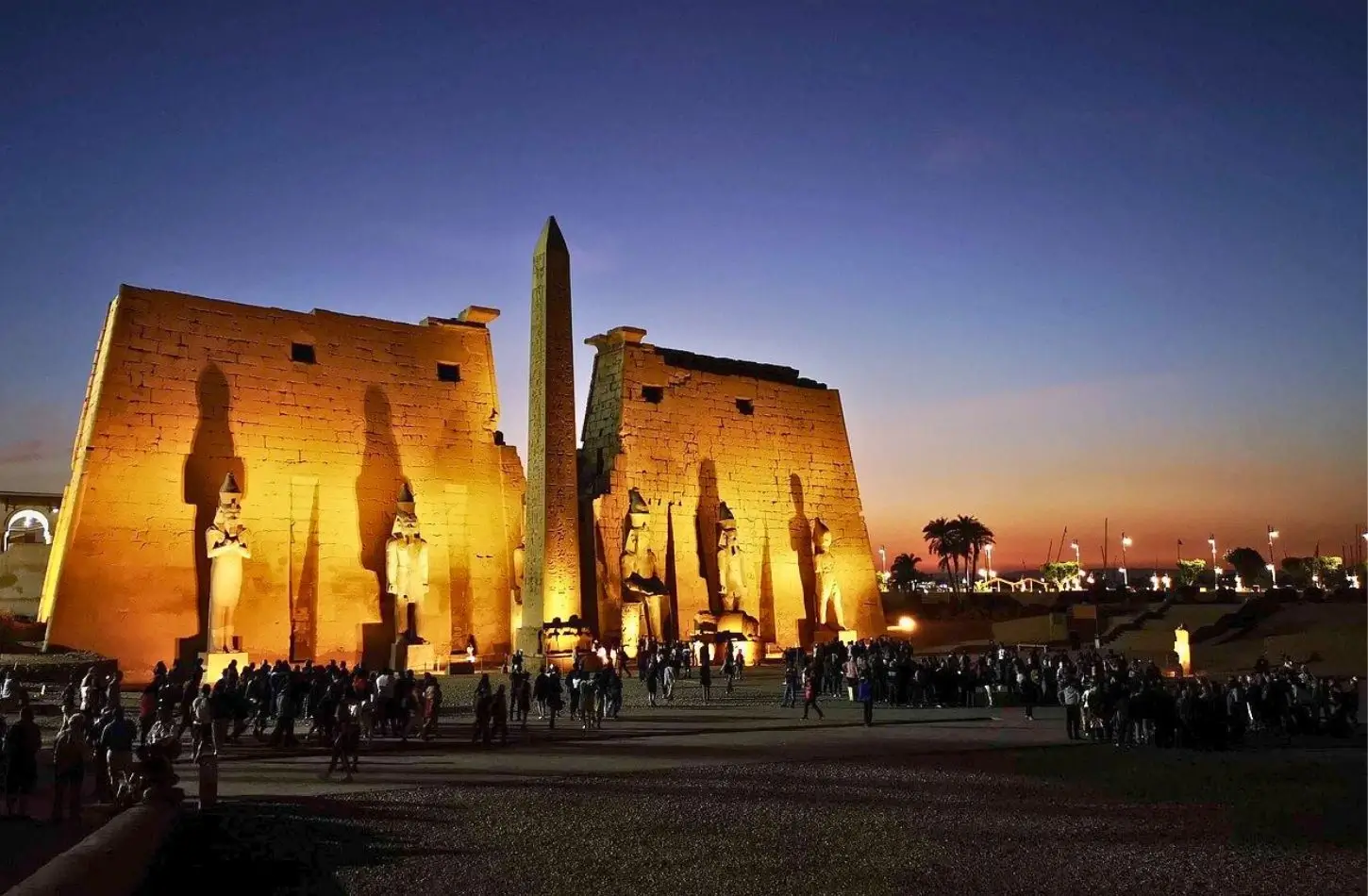
Luxor Temple is dramatically floodlit at night, making the evening far more atmospheric & cooler than a midday visit in the open courtyards.
🕌 4 religions share one site
pharaonic temple, Roman chapel, Coptic church & an active 13th-century mosque all occupy the same ground, unique anywhere in the world.
🎟️ Tickets ~500 EGP for foreigners
open daily from 6 AM; combine with Karnak & Valley of the Kings on a single guided Luxor day tour for the best value.
Luxor Temple is a 3,400-year-old sanctuary on the east bank of the Nile in Luxor, built around 1400 BC by Pharaoh Amenhotep III and dedicated to the god Amun. Unlike most Egyptian temples, it wasn’t built to honor a single deity in isolation — it was the stage for the rejuvenation of kingship itself, where pharaohs symbolically renewed their right to rule during the annual Opet Festival. Today, the temple stands almost fully intact in the heart of modern Luxor, illuminated dramatically at night and within walking distance in under two hours, making it one of the easiest ancient wonders in Egypt to experience firsthand. Many visitors pair it with Karnak Temple on one of Tripianto’s guided Luxor tours to see both sites with an Egyptologist explaining the history on-site.
A Brief History of Luxor Temple
Luxor Temple’s history begins in the New Kingdom, during the 18th Dynasty, when Thebes (modern Luxor) was the religious capital of Egypt. Amenhotep III commissioned the temple around 1400 BC on the site of an earlier, smaller sanctuary, intending it as a southern counterpart to the massive Karnak Temple complex two miles north. Its original name, Ipet-resyt, meant “the southern sanctuary,” and it served as the ceremonial endpoint of the Opet Festival — an annual procession in which statues of Amun, Mut, and Khonsu traveled from Karnak to Luxor along the Avenue of Sphinxes.
Construction didn’t stop with Amenhotep III. Tutankhamun and Horemheb added decoration and structural elements after his death, and Ramesses II later expanded the temple significantly, adding the first pylon, a new peristyle court, and two seated colossi of himself flanking the entrance — along with two obelisks, one of which now stands in Paris’s Place de la Concorde.
The temple’s layered history didn’t end with the pharaohs. Under Roman rule, the hypostyle hall was converted into a chapel for the imperial cult, and a Roman legion was garrisoned at the site — the origin of the city’s modern Arabic name, Al-Uqsur (“the fortifications”), which became “Luxor.” Centuries later, Coptic Christians built a church within the temple grounds, and in the Fatimid period, a mosque dedicated to the Sufi saint Abu al-Hajjaj was constructed over part of the site — it still stands today, fully integrated into the temple complex, making Luxor Temple one of the only places on Earth where four religious traditions occupy the same footprint.
Who Was Luxor Temple Dedicated To? The Deity Behind the Stone
Luxor Temple’s deity is Amun, the chief god of the Theban triad alongside his consort Mut and their son Khonsu. But the temple’s purpose went deeper than worshipping a single god — its central function was the renewal of kingship. During the Opet Festival, the reigning pharaoh entered the temple’s inner sanctuary to be ritually reunited with Amun’s divine power, reaffirming his legitimacy to rule for another year.
This is also why Alexander the Great, centuries later, claimed to have been crowned at Luxor Temple — even though historians dispute whether he ever traveled this far south. A dedicated chapel near the rear of the temple, decorated with reliefs of Alexander dressed as a pharaoh, still reflects this attempt to fold a foreign conqueror into Egypt’s ancient framework of divine kingship.
Luxor Temple Construction: How It Was Built
Luxor Temple’s construction unfolded over roughly 180 years and multiple reigns, using sandstone quarried from Gebel el-Silsila, around 100 miles south. Workers transported the stone blocks by barge along the Nile during the annual flood season, when river levels made transport easier. Columns, pylons, and statues were carved on-site by hand with copper and bronze tools, and then decorated with reliefs depicting military victories, religious processions, and divine scenes.
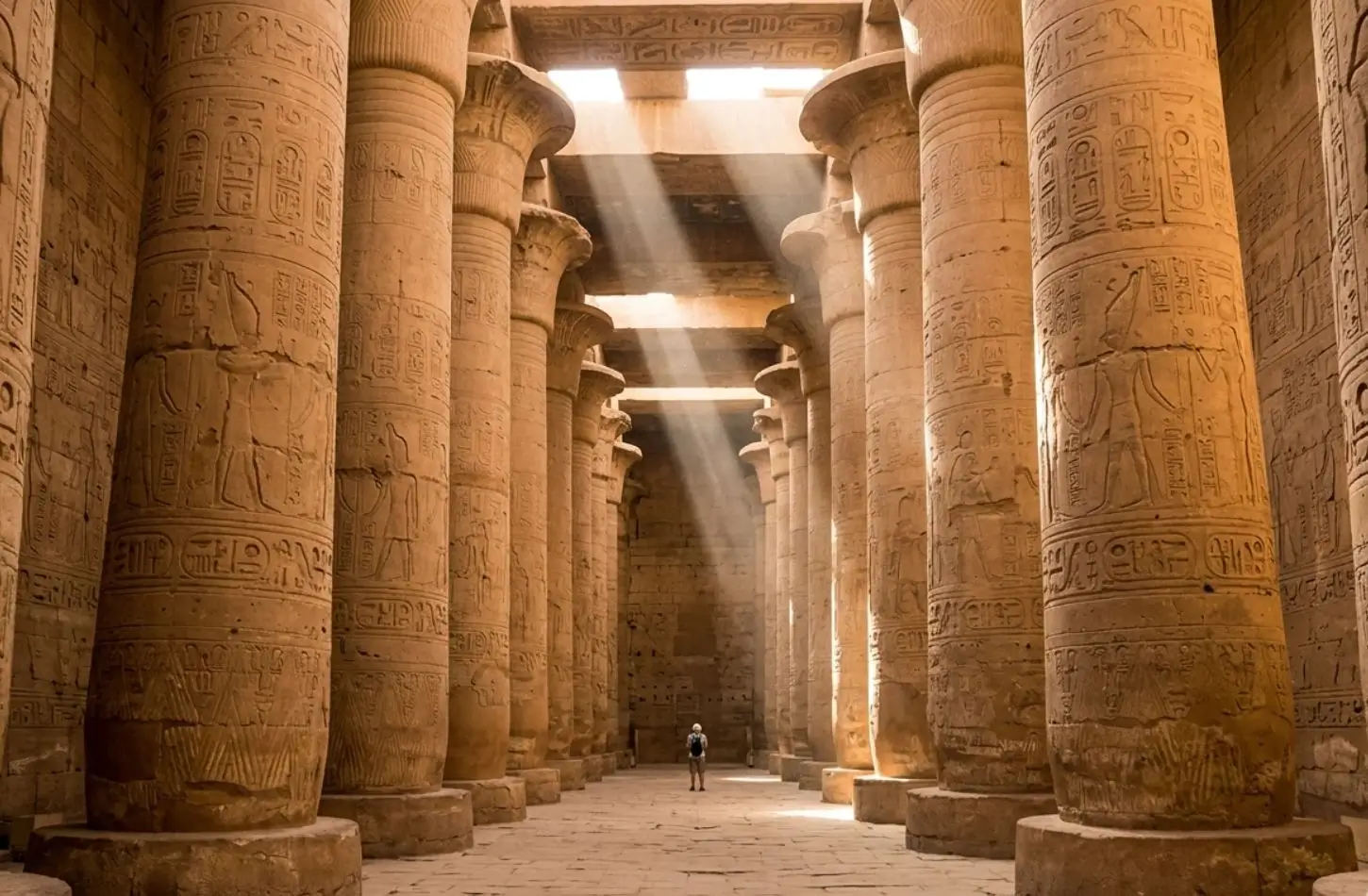
The temple’s most striking architectural feature is its colonnade of 14 papyrus-bud columns, each over 50 feet tall, built by Amenhotep III and completed under Tutankhamun. Ramesses II’s later additions — the first pylon, the great court, and the colossal entrance statues — used a different architectural rhythm, which is why the temple’s layout subtly shifts axis partway through, a detail historians attribute to the original alignment with an earlier sanctuary on the site.
Best Time to Visit Luxor Temple
The best time to visit Luxor Temple in Egypt is during the cooler months of October through April, when daytime temperatures stay comfortable enough for unhurried exploration. Between June and August, midday heat regularly climbs above 40°C (104°F), making the unshaded courtyards and colonnade genuinely uncomfortable — visiting at sunrise or after sunset becomes less a preference and more a necessity in summer.
Within any season, early morning (just after opening) and the hour around sunset offer the best combination of soft light and thinner crowds, since most tour groups arrive mid-morning. If your schedule allows only one visit, late afternoon into early evening is the strongest choice: you catch the temple in natural golden light before sunset, then watch it shift into its floodlit night appearance without needing a separate trip.
Luxor Temple vs. Karnak Temple: What’s the Difference?
Luxor Temple and Karnak Temple are often mentioned together, but they’re distinct sites built for different purposes. Karnak is the larger of the two by a wide margin — a sprawling 200-plus-acre complex with the famous 134-column Great Hypostyle Hall, a sacred lake, and multiple sanctuaries built up over centuries by successive pharaohs. Luxor Temple is smaller and more contained, and was purpose-built as the ceremonial destination of the Opet Festival, the annual procession that renewed the pharaoh’s divine kingship.
In practical terms, Karnak typically needs 2–3 hours to see properly and rewards a guide who can navigate its scale, while Luxor Temple is compact enough to cover well in 60–90 minutes. Most visitors see Karnak in the morning when light and energy are both fresher, then end the day at Luxor Temple in the late afternoon or evening, when its floodlighting and smaller scale make for a more atmospheric finish.
Luxor Temple Opening Hours & Ticket Prices
Luxor Temple is open daily, typically from 6:00 AM to around 7:00 PM, though exact closing times can shift slightly with the season — always confirm current hours before you go. As of recent pricing, foreign adult tickets run approximately 500 EGP, with discounted student rates around 250 EGP; Egyptian nationals pay a separate, lower local rate. Tickets are purchased at the on-site ticket office, and Luxor Temple is also included in the multi-site Luxor Pass for travelers planning to visit several monuments.
Prices and hours change periodically — treat the figures above as a planning guide and confirm current rates closer to your travel date.
Luxor Temple at Night vs. During the Day
Luxor Temple is one of the rare ancient sites that’s arguably more striking after dark than in daylight. By day, the sandstone reads warm and golden, and you can examine relief carvings and hieroglyphs in full detail. After sunset, dramatic floodlighting throws deep shadows across the colossi and columns, giving the ruins a theatrical quality that daylight photos don’t capture — it’s a large part of why many guides recommend ending a Luxor day here rather than starting it.
Daytime visits are better suited to travelers who prioritize fine-detail photography or to those touring with an Egyptologist guide, who needs good light to point out specific reliefs. Evening visits suit travelers who want atmosphere over detail, and tend to be slightly cooler and less crowded as well.
Beyond the headline history, a few specific facts make a visit to Luxor Temple far more rewarding:
- It’s one of the best-preserved temples in Egypt, with much of its original structure — including columns, pylons, and colossi — still standing.
- The Avenue of Sphinxes, a 1.7-mile processional road lined with sphinx statues, once connected Luxor Temple directly to Karnak Temple and has recently been restored for walking.
- One of the temple’s original obelisks was gifted to France in 1829 and now stands in the Place de la Concorde in Paris; its twin remains at the temple entrance.
- A 14th-century mosque, the Mosque of Abu al-Hajjaj, sits directly atop part of the ancient temple — deliberately preserved rather than removed during 19th-century excavations.
- The temple is dramatically lit after sunset, and many visitors consider the evening visit more atmospheric than the daytime one.
Luxor Temple Key Facts at a Glance
| Detail | Fact |
|---|---|
| Location | East bank of the Nile, central Luxor (ancient Thebes) |
| Founded | c. 1400 BC, under Amenhotep III |
| Egyptian name | Ipet-resyt — “the southern sanctuary” |
| Dedicated to | Amun, alongside Mut and Khonsu (the Theban Triad) |
| Main builders | Amenhotep III, Tutankhamun, Horemheb, Ramesses II |
| Construction span | Roughly 180 years across multiple reigns |
| UNESCO status | Part of “Ancient Thebes with its Necropolis,” inscribed 1979 |
| Average visit time | 60–90 minutes |
How to Visit Luxor Temple: Practical Tips
Luxor Temple sits directly in central Luxor, within easy walking distance of the Nile corniche, the Luxor Museum, and most riverside hotels — no need to arrange transport if you’re already staying nearby. Entry tickets are sold at the site, though prices and hours can change seasonally, so it’s worth confirming current rates before you go.
Most visitors spend 60 to 90 minutes exploring the temple at a comfortable pace, though history enthusiasts often linger longer to study the reliefs in the hypostyle hall. The site can be visited independently, but a licensed Egyptologist guide adds significant value here — much of what makes Luxor Temple remarkable (the shifting building axis, the Alexander chapel, the layered religious history) isn’t explained on any posted signage.
Many travelers pair Luxor Temple with Karnak Temple on the same day, since the two sites were historically connected and are only a short drive apart. If you’re planning a broader trip, Tripianto’s guided Luxor tour packages combine both temples with the Valley of the Kings and other East and West Bank highlights, with an Egyptologist guide handling tickets, timing, and historical context throughout.
Travelers drawn to the site’s ceremonial history often prefer our Egypt Spiritual Tours, which build in unhurried, meditative time at Luxor and Karnak rather than a standard sightseeing pace.
Frequently Asked Questions About Luxor Temple
Who built the Luxor Temple?
This is the most common historical question. Unlike other temples that were built by a single ruler, Luxor Temple was constructed over centuries. It was largely started by Amenhotep III (who built the elegant inner sun court and colonnade) and later expanded significantly by Ramesses II (who added the massive front entrance gateway, obelisks, and giant statues of himself). Later additions were even made by Alexander the Great.
What is the difference between Karnak Temple and Luxor Temple?
First-time visitors always get these two confused since they are located in the same city. Karnak Temple is a massive, sprawling religious complex (the largest in Egypt) that served as the main center of worship. Luxor Temple is smaller and more compact, and was primarily used as a ceremonial space for festivals—specifically the annual Opet Festival, during which statues of the gods were paraded from Karnak to Luxor Temple.
How are Karnak and Luxor Temples connected?
People frequently search for the physical link between the two sites. They are connected by the iconic Avenue of Sphinxes (also known as Kebash Road). It is a 2.7-kilometer (1.7-mile) ancient ceremonial pathway lined with hundreds of sphinx statues that was fully restored and reopened to the public in late 2021.
What is the best time to visit Luxor Temple?
From a seasonal perspective, search trends peak between October and April when Egypt’s winter weather is comfortably warm. On a daily level, the top recommendation is to visit at sunset or during the evening. Unlike many other ancient sites that close at dusk, Luxor Temple is spectacularly lit up at night, making it much cooler and visually stunning to explore after dark.
Why is there a mosque inside Luxor Temple?
Many sharp-eyed travelers search for this after seeing images of the site. Standing atop the ancient ruins is the active Abu Haggag Mosque. It was built in the 13th century when the ancient temple was almost completely buried under centuries of accumulated silt and debris. At the time, the ground level was much higher. Today, it stands as a unique testament to the site’s continuous layer of history spanning thousands of years.
Conclusion
Few ancient sites pack as much layered history into a single, walkable location as Luxor Temple — a sanctuary built for the renewal of kingship that later became a Roman fortress, a Christian chapel, and an active mosque, all without ever losing its pharaonic core. Seeing it in person, especially with a guide who can point out details like the temple’s shifting axis or the Alexander the Great chapel, turns a 90-minute visit into one of the most memorable stops on a Nile itinerary. Explore Misk Tours’ Luxor tour packages to combine Luxor Temple with Karnak and the West Bank in a single, expertly guided day.
