



Last verified: May 2026
Quick Answer
🏛️ What are the most important ancient Egyptian temples & what should you know before visiting?
Egypt has over 100 surviving ancient temples spanning 3,000 years of construction — from Luxor’s Karnak (the world’s largest religious complex) to Abu Simbel’s rock-cut giants. They served as divine homes, royal tombs, and cosmic symbols — not simply places of worship.
Abu Simbel, Aswan
Two rock-cut temples by Ramesses II (1264 BCE) · solar alignment event Feb 22 & Oct 22 · entry ~450 EGP
Karnak Temple, Luxor
World’s largest ancient religious site · 134 hypostyle columns · built over 2,000 years · entry ~450 EGP
Philae Temple, Aswan
Dedicated to goddess Isis · relocated to save from Nile flooding · accessible by boat · entry ~180 EGP
Visitor tip
Arrive before 8am at all temples — cooler, quieter, and the golden light makes hieroglyphs far easier to read and photograph
Stand in the hypostyle hall at Karnak just after dawn and something happens that no photograph prepares you for — three thousand years of stone pressing down, columns wider than a man’s armspan catching the first light, and the overwhelming sense that you are somewhere that has no equivalent anywhere else on earth.
Ancient Egyptian temples are older than every cathedral in Europe, every mosque, and the Parthenon. More than one hundred survive along the Nile, from Alexandria to Abu Simbel — and unlike every other religious building tradition you have encountered, they were not built for people. They were built as literal homes for the gods. Priests performed daily rituals of washing, dressing, and feeding the divine cult statue. Ordinary Egyptians never crossed into the inner sanctuaries. The pharaoh himself was, technically, a visitor.
That single inversion — god at the centre, humanity held respectfully at a distance — is what you feel the moment you walk from bright desert light into the progressive darkness of a temple’s innermost hall. It is still communicating, three thousand years later.
This guide covers the history of ancient Egyptian temples, their architecture and symbolism, the eight temples that matter most, and how to plan an itinerary worthy of them. If you are ready to go, our Luxor tours and Nile cruises include licensed Egyptologist guides who bring every column in this guide to life in person.
The History of Ancient Egyptian Temples — Three Thousand Years in Stone
The history of Ancient Egyptian Temples spans three thousand years, from the Old Kingdom mortuary complexes at Giza to the Ptolemaic temples built under Greek and Roman rule. What makes these Ancient Egyptian Temples remarkable is the consistency of their design: the pylon gateway, hypostyle hall, and inner sanctuary remained central features for millennia.
The Old Kingdom established the template for Ancient Egyptian Temples, while the Middle Kingdom expanded temple construction across the Nile Valley. The New Kingdom marked the golden age of Ancient Egyptian Temples, with monumental projects at Karnak and Abu Simbel showcasing Egypt’s wealth and religious devotion. The Ptolemaic period brought a final flourishing of Ancient Egyptian Temples, producing some of the best-preserved examples, including Edfu, Kom Ombo, Philae, and Dendera.

The Eight Ancient Egyptian Temples Every Visitor Should Know
Egypt’s temples range from the colossal to the intimate. The eight below represent the full range of periods, types, and experiences available to visitors — from the overwhelming scale of Karnak to the island serenity of Philae. Each one is different enough from the others to justify visiting all of them if your itinerary allows.
Karnak Temple Complex, Luxor
East Bank, Luxor · open daily 6am–5:30pm (summer to 6pm)
The largest ancient religious site ever built, covering approximately one hundred hectares and constructed continuously over three thousand years by thirty different pharaohs. What survives is primarily the Temple of Amun at its centre, but the complex also includes temples to Mut, Khonsu, and Montu, a sacred lake, an avenue of ram-headed sphinxes connecting to Luxor Temple three kilometres south, and the famous hypostyle hall — 134 columns, some over twenty metres tall, every centimetre covered in carved and originally painted relief. The Avenue of Sphinxes, newly restored, links Karnak to Luxor Temple on a processional route used by pharaohs for millennia. The sound and light show held most evenings is worth attending for the spatial experience of the complex at night, independent of the commentary.
Best for: First-time visitors, architectural scale, photography Allow: 3–4 hours minimum
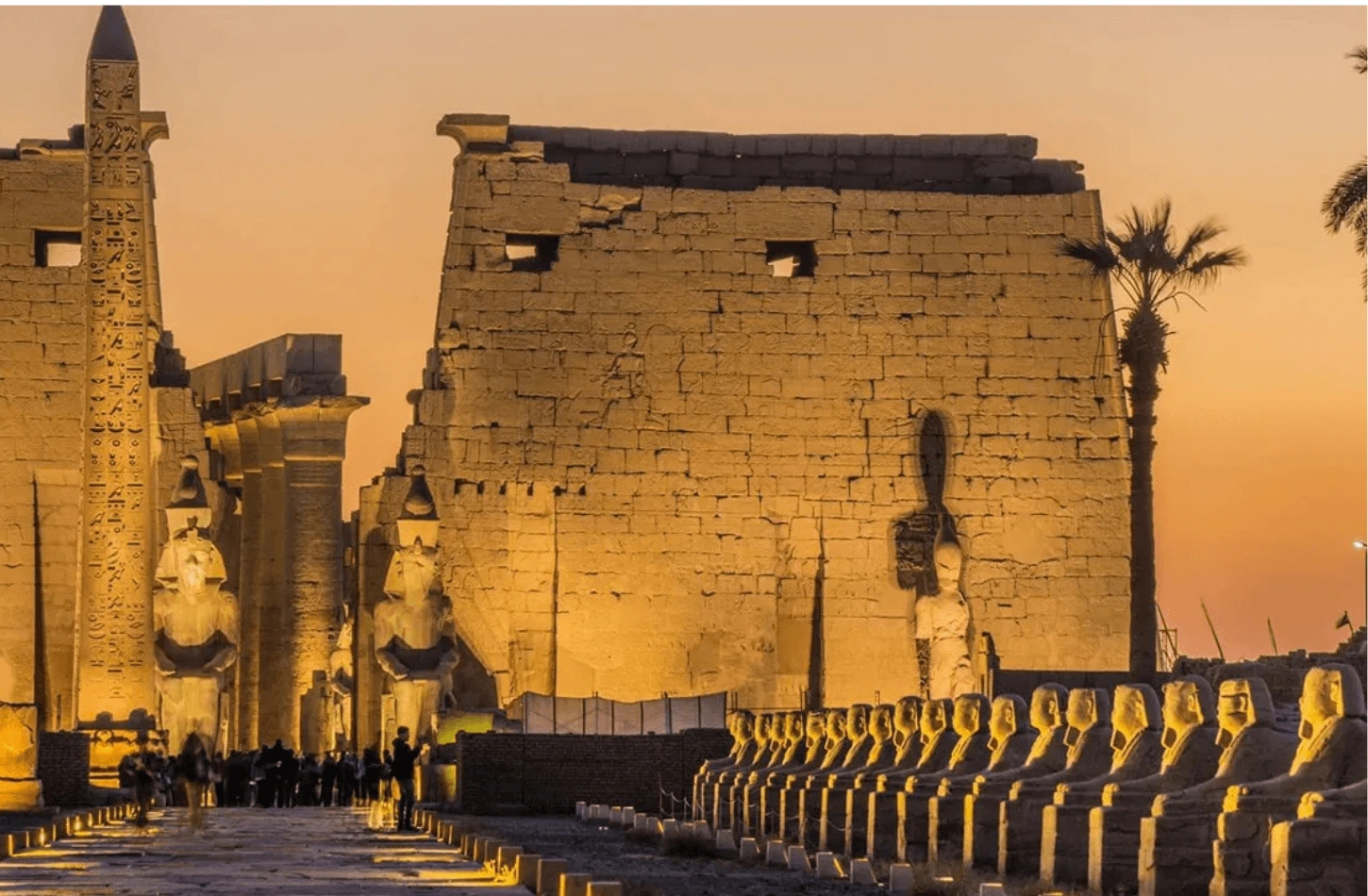
Safaa tip Book a Luxor day tour that pairs Karnak with Luxor Temple — entering Karnak at opening (6am) and Luxor Temple at dusk when it is illuminated. The two temples bookend the day perfectly and share the same processional axis.
Luxor Temple
East Bank, Luxor city centre · open daily 6am–10pm
Built primarily by Amenhotep III and expanded significantly by Ramesses II, Luxor Temple sits on the east bank of the Nile at the heart of modern Luxor — a jarring and magnificent juxtaposition of ancient stone and busy city streets. Its entrance pylon is flanked by a single standing obelisk (the second stands in the Place de la Concorde in Paris, removed in 1833) and two seated colossi of Ramesses II. Inside, the peristyle court and colonnaded hall lead to an inner sanctuary later converted to a Roman legionary chapel, with Roman paintings still visible above the hieroglyphic relief beneath. The temple is particularly remarkable at dusk, when the floodlighting transforms the honey-coloured stone into something intensely theatrical.
Best for: Evening visit, city context, photography at dusk Allow: 1.5–2 hours
Abu Simbel, Aswan
280km south of Aswan · fly or 3–4 hr drive · open daily 5am–6pm
The most visited UNESCO World Heritage Site in Egypt and one of the great architectural spectacles of the ancient world. Two rock-cut temples — the Great Temple of Ramesses II, with its four colossal sixty-seven-tonne façade statues, and the smaller Temple of Nefertari — were carved directly into the sandstone cliffs of Nubia in the thirteenth century BCE. Their extraordinary 1964–1968 relocation, cutting them into blocks and reassembling them sixty metres higher to save them from the rising waters of Lake Nasser, is an engineering achievement almost as extraordinary as the original construction. Twice a year — on 22 February and 22 October, dates corresponding to Ramesses II’s birthday and coronation — sunlight penetrates 55 metres into the Great Temple and illuminates the sanctuary statues with a precision that confirms the original alignment was deliberate.
Best for: Scale, engineering marvel, solar event Allow: 2–3 hours at the site
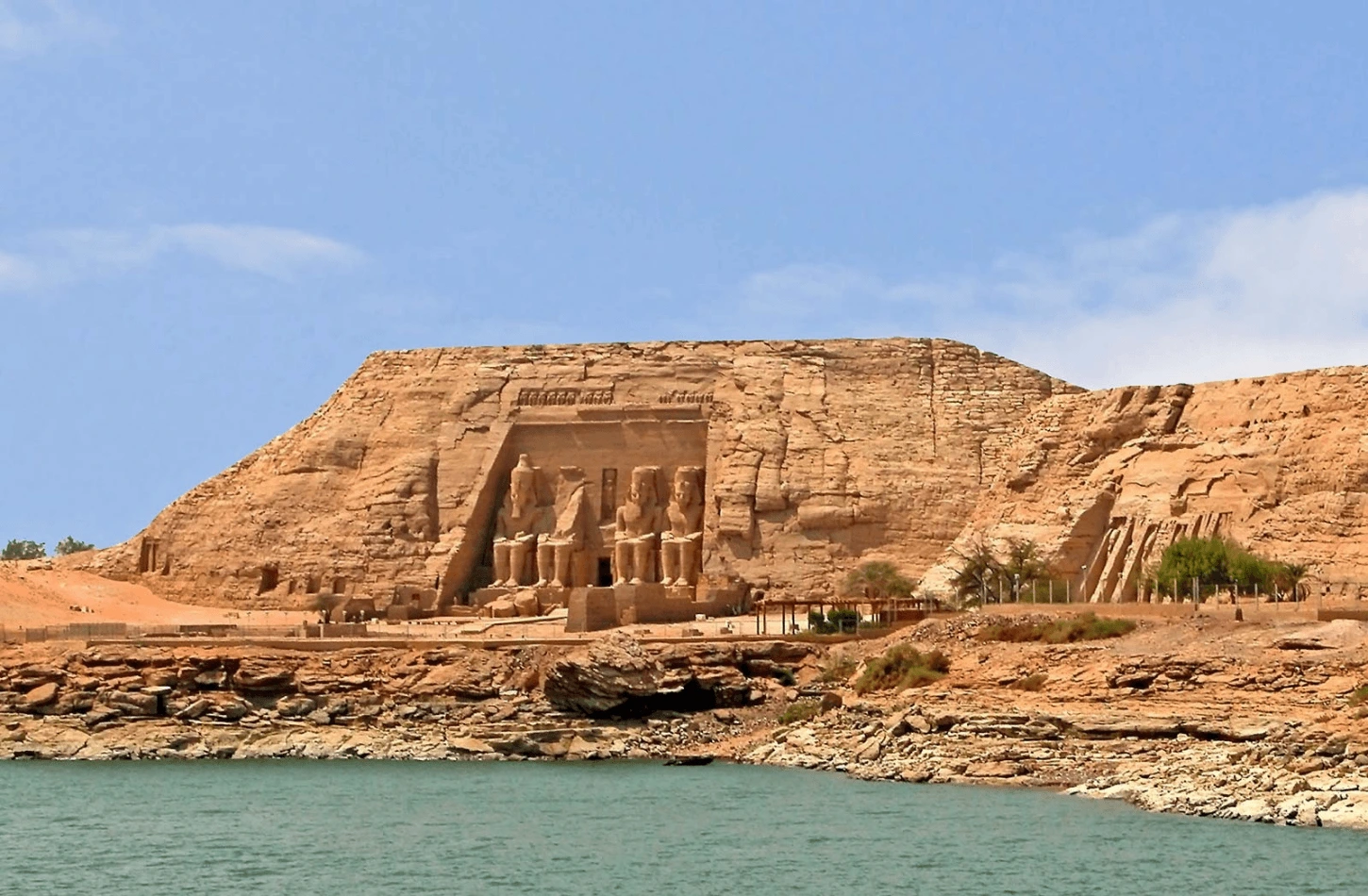
Safaa tip Abu Simbel is most efficiently visited on a day flight from Luxor or Aswan. Our Aswan tours include Abu Simbel excursions with an Egyptologist guide who makes the alignment and the relocation story genuinely intelligible — not just a list of statistics.
Edfu Temple (Temple of Horus)
Edfu, between Luxor and Aswan · open daily 7am–5pm (6pm summer)
The best-preserved ancient temple in Egypt, built between 237 and 57 BCE and dedicated to Horus the falcon god. Because it was buried under desert sand for centuries, its roof, walls, and pylons survive nearly complete — a condition no New Kingdom temple can match. Walking through Edfu is the closest experience available to understanding what an ancient Egyptian temple actually looked like when it was in daily use: the sequence of spaces from open court to hypostyle hall to inner sanctuary is fully intact, the walls covered in dense hieroglyphic text recording the theology and rituals of the temple in extraordinary detail. Edfu is a standard stop on Egypt Nile cruises between Luxor and Aswan.
Best for: Best-preserved experience, understanding temple layout Allow: 1.5–2 hours
Philae Temple (Temple of Isis), Aswan
Agilkia Island, Aswan · accessible by boat · open daily 7am–5pm
Dedicated to Isis, goddess of magic and healing, the Philae complex was the last functioning ancient Egyptian temple, remaining in active use as late as the sixth century CE before being closed by Byzantine decree. Like Abu Simbel, it was relocated in the 1970s — this time from its original island of Philae, now submerged, to the neighbouring island of Agilkia. The setting is extraordinary: the approach by motorboat across the waters of Lake Nasser, the island rising ahead with columns visible above the shoreline, remains one of the most beautiful arrivals in Egyptian travel. The reliefs inside are among the finest of the Ptolemaic period, and the sound and light show here, held most evenings, uses the island setting to remarkable effect.
Best for: Island setting, Isis mythology, sound & light show Allow: 1.5–2 hours including the boat
Mortuary Temple of Hatshepsut, Deir el-Bahri
Deir el-Bahri, West Bank Luxor · open daily 6am–5pm
The mortuary temple of Hatshepsut — Egypt’s most powerful female pharaoh, who ruled as king for over twenty years in the fifteenth century BCE — is one of the most architecturally distinctive structures in the ancient world. Its three colonnaded terraces rise against the sheer limestone cliffs of Deir el-Bahri in a design unlike any other Egyptian temple, typically attributed to the royal architect Senenmut. The walls of its porticoes contain reliefs of extraordinary quality: the famous trading expedition to the land of Punt, scenes from Hatshepsut’s divine birth, and depictions of the transportation of her two Karnak obelisks. The temple is best visited in conjunction with the Valley of the Kings, a short drive away on the same West Bank circuit.
Best for: Architecture, reliefs, female pharaoh history Allow: 1.5 hours
Kom Ombo Temple
Kom Ombo, 45km north of Aswan · open daily 9am–6pm
Unique in the Egyptian canon for its perfectly symmetrical double layout: the left half of the temple is dedicated to Sobek the crocodile god, the right half to Haroeris (a form of Horus). Each side has its own entrance, hypostyle hall, sanctuary, and set of reliefs — an architectural expression of the dual nature of the deities worshipped here, gods of opposing principles united in a single sacred space. The temple contains an intact Nilometer for measuring the annual flood, a collection of mummified crocodiles in an adjacent museum, and some of the finest surviving surgical instrument reliefs in Egypt, carved on a rear corridor wall. Another standard Nile cruise stop, Kom Ombo is particularly beautiful at sunset when the sandstone glows amber above the river.
Best for: Unique double layout, Nile views, crocodile mythology Allow: 1–1.5 hours
Dendera Temple (Temple of Hathor)
Dendera, 60km north of Luxor · open daily 8am–6pm
Dedicated to Hathor, goddess of love, music, and beauty, Dendera is among the most complete ancient temples in Egypt and the one that best preserves its original polychrome ceiling paintings. The astronomical ceiling of the outer hypostyle hall — a zodiac and astronomical calendar of extraordinary complexity — is still partly visible in situ, though the original Dendera Zodiac is now in the Louvre. The temple’s crypts, accessible by narrow staircases, contain some of the most enigmatic relief carvings in Egypt, which have attracted considerable attention in recent decades. The façade columns, with their distinctive Hathor-head capitals, are among the most immediately recognisable images in Egyptian temple architecture.
Best for: Painted ceilings, astronomical reliefs, crypts Allow: 1.5–2 hours
How to Plan Your Ancient Egyptian Temple Itinerary
The most common mistake is overloading days. Temples reward time, not quantity. Pair sites that share geography and complement each other — and always prioritise early mornings at open-air sites.
Luxor: two days. Day one is the East Bank — Karnak at 6am before the heat builds, Luxor Temple at dusk when floodlighting turns the stone incandescent. They share a processional axis; visiting both on the same day makes that relationship clear. Book a Luxor day tour with a licensed Egyptologist. Day two is the West Bank — Hatshepsut’s temple at Deir el-Bahri, the Valley of the Kings, and Medinet Habu. These three are a short drive apart and cover the full range of New Kingdom mortuary architecture.
Aswan: a day and a half. Philae (morning boat to Agilkia Island) pairs with the High Dam on day one. Abu Simbel is a half-day flight excursion — 6am departure, two hours at the site, back by noon. Our Aswan tours include both with guided commentary.
Nile cruise: the most efficient option. A four- or five-night Nile cruise between Luxor and Aswan stops at Edfu and Kom Ombo en route, with an Egyptologist guide making each successive temple more legible. For hotel travellers, a classic Egypt package covers Cairo, Luxor, and Aswan with full flexibility.
Timing: October to April is the best window — 15–25°C in Upper Egypt versus 40°C+ in summer. Open-air sites belong in the early morning; enclosed temples are comfortable at any hour; Luxor Temple always at evening.
What Makes Ancient Egyptian Temples Unlike Any Other Sacred Architecture
What makes Ancient Egyptian Temples truly unique is not simply their age or scale, but the entirely different religious world they represent. Built as the private homes of the gods rather than places for public worship, these temples followed a sacred architectural logic that guided priests from the outside world into increasingly restricted divine spaces. Even today, visitors can experience that same progression of light, space, and silence that shaped ritual life thousands of years ago.
Combined with their vast inscriptions, theological texts, and remarkably preserved structures, Ancient Egyptian Temples offer an unparalleled record of an ancient civilization’s beliefs and practices. No other sacred architecture preserves the relationship between humans and the divine with such completeness, making these temples among the most extraordinary religious monuments ever created.
Frequently Asked Questions — Ancient Egyptian Temples
What is the most famous ancient Egyptian temple?
Karnak in Luxor is the largest ancient temple complex in the world and the most visited. Abu Simbel is the most internationally recognised — its four colossal 20-metre façade statues are among the defining images of ancient Egypt. For preservation, Edfu wins: roof, walls, and pylon survive nearly complete.
How many ancient Egyptian temples survive?
Over one hundred, in varying states of preservation. The greatest concentration runs along the Nile between Luxor and Aswan. Karnak alone contains more than twenty separate structures.
What were ancient Egyptian temples used for?
They were the earthly homes of the gods — priests performed daily rituals (washing, dressing, feeding the cult statue) on behalf of the pharaoh. They were also major economic institutions; Karnak’s temple of Amun controlled roughly a third of Egypt’s agricultural land at its peak.
Which temple is best to visit first?
Karnak — its scale and variety make it the most comprehensive introduction. Pair it with Luxor Temple the same day. If you want to understand how temples functioned spatially, choose Edfu: it is the most complete.
When is the best time to visit?
October to April, when Upper Egypt sits at 15–25°C. Arrive at open-air sites at opening; save enclosed temples and Luxor Temple for later in the day or evening.
Do I need a guide?
A licensed Egyptologist guide makes a significant difference — particularly at Karnak, where scale alone is disorienting, and at sites like Hatshepsut and the Valley of the Kings where the iconography rewards explanation.
What is the difference between a cult temple and a mortuary temple?
A cult temple was the permanent home of a state deity — Horus at Edfu, Amun at Karnak. A mortuary temple served the ongoing cult of a specific dead pharaoh. Hatshepsut’s temple at Deir el-Bahri and Medinet Habu are the finest surviving mortuary temples. Most major complexes served both functions.
In Conclusion
Verily, the temples of the Nile valley stand as enduring monuments to the faith and artistry of the ancient Egyptians. These sacred precincts were not merely houses of the gods, but vibrant hubs where life and ritual intertwined. Within their hallowed halls, pharaohs sought divine favor, while the faithful brought offerings and witnessed ceremonies that mirrored the grand dramas of the cosmos. Thus, these temples served as testaments to both the earthly and the divine, forever etching the beliefs and aspirations of a bygone era upon the sands of time.
To truly appreciate the majesty of these ancient temples, plan your visit during the cooler months—typically from October to April. During this season, the weather is pleasant, the Nile shimmers under soft sunlight, and exploring monumental sites like Karnak, Abu Simbel, and Philae becomes a comfortable and unforgettable experience.
