
By Nada Safwat | Last updated May 2026
I’ve spent six years shopping Cairo’s markets every week — not as a tourist, but as someone who sources gifts, props for tour groups, and the occasional thing for my own home. I’ve been overcharged, I’ve found extraordinary pieces, and I’ve watched hundreds of travelers walk past the best stalls to buy something mass-produced from a hotel lobby.
This guide is what I tell people before they go shopping. Thirty items I’d actually buy, with honest 2026 prices in both EGP and USD, specific market addresses, and the authenticity tests I use myself. Plus: five things tourists consistently overpay for, and exactly what to buy instead.
How to spot real vs. fake: 5 quick checks before you pay
Egypt’s markets are full of authentic treasures — and an equal number of cheap replicas, many of which are manufactured abroad. Before we get to what to buy, here are the five checks I use every week.
Check 1: Papyrus (the roll check)
Hold the scroll and gently roll it into a loose cylinder, then release. Genuine papyrus — made from the cross-hatched fibers of the Cyperus papyrus plant — springs flat and stays flexible. Fake papyrus made from banana leaf or compressed card will crinkle, crack along the fold, or not recover its shape. If a vendor refuses to let you do this test, walk away.
Check 2: Egyptian cotton (the hologram sticker)
The Egyptian Textile Consolidation Fund certifies genuine long-staple cotton with a holographic sticker on the packaging. No sticker = no guarantee. Additionally, hold the fabric up to light: genuine Egyptian cotton has a consistent, slightly translucent weave. If it’s thick and opaque like a flannel, it’s a cotton blend at best.
Check 3: Silver (the hallmark check)
Legitimate Egyptian silver jewelry is stamped with a government hallmark — either 925 (sterling) or 800 — on the clasp or a flat section of the piece. You’ll need to look closely; bring a small magnifier if you plan to shop for jewelry. No hallmark means it’s silver-plated at best, and the plating will wear off within months.
Check 4: Perfume oil (the dilution check)
Apply a small amount to the back of your hand and wait 60 seconds. A genuine, concentrated Egyptian essence will retain its scent for a minute and gradually evolve over 20–30 minutes. A diluted imitation (alcohol base with a splash of scented oil) will smell sharp initially, then fade quickly. Also, ask the vendor for the concentration ratio — reputable shops will tell you.
Check 5: Alabaster (the light check)
Hold the piece up to a torch or bright window. Genuine alabaster is translucent — you will see a warm glow through the stone, especially at thinner edges. Resin and plastic replicas are opaque or show a uniform artificial color. Also feel the weight: alabaster is notably heavier than plastic of the same size.
23 souvenirs we would actually buy — with 2026 Cairo prices
The prices below are confirmed based on on-the-ground visits in Cairo in April 2026. EGP prices are given first; USD conversions use the April 2026 rate of approximately EGP 49 = USD 1. Prices at tourist-facing shops near major sites will be 30–60% higher than the market prices listed here.
1- Authentic papyrus art
Genuine hand-painted papyrus depicting scenes from the Book of the Dead, hieroglyphic alphabets, or Nile landscapes. A medium scroll (A3 size) makes a remarkable wall piece that will last decades. Avoid anything machine-printed — the brushwork on an authentic piece has visible variation in line weight.
Price: EGP 150–600 ($3–$12) budget | EGP 600–1,800 ($12–$37) mid | EGP 1,800–8,000+ ($37–$163) premium (large hand-painted, framed)
Where to buy: Khan El-Khalili (Cairo), Pharaoh’s Papyrus Institute (Giza), artisan stalls in Luxor’s West Bank
Authenticity check: Use the roll test (see above). Ask to see the raw papyrus sheets before purchase.
Budget versions, such as bookmarks and postcards, are also widely available.
Want to find the best papyrus dealers without the guesswork? Our Egypt Day Trips include stops at trusted workshops where you can watch the process and buy directly from the source.
2- Egyptian cotton products (bedding & towels)
Egyptian long-staple Giza cotton is genuinely world-class — softer, stronger, and more breathable than standard cotton. Whether you choose bed linens, pillowcases, or flat-woven hammam towels (fouta), you’re buying something that gets better with every wash and outlasts anything you’d find at home. Fouta towels in particular are one of Egypt’s best-kept souvenir secrets — they pack flat into carry-on luggage, and most travelers who discover them buy several.
Price (bedding): EGP 250–600 ($5–$12) per pillowcase | EGP 800–2,200 ($16–$45) per sheet | EGP 2,500–6,000 ($51–$122) full set
Price (towels): EGP 150–300 ($3–$6) fouta | EGP 300–700 ($6–$14) thick terry | EGP 700–1,800 ($14–$37) premium hotel-weight set
Where to buy: Wekalet El-Balah Market (Cairo), Nile Cotton shops (Zamalek/Heliopolis), textile markets in Luxor
Authenticity check: Look for the Egyptian Textile Consolidation Fund hologram sticker on packaging. Pull a few fibers and burn them — cotton smells like paper and forms a soft ash. Synthetic smells like plastic and forms a hard bead.
3- Galabeya (traditional robe)
The Egyptian full-length robe, worn by men and women alike, is one of the most practical souvenirs you can buy: light, cool, and actually worn daily by millions of Egyptians. Cotton galabeyas are ideal; embroidered Saidi versions from Upper Egypt are particularly beautiful.
Price: EGP 200–500 ($4–$10) plain cotton | EGP 500–1,500 ($10–$31) embroidered | EGP 1,500–4,000 ($31–$82) silk or premium embroidery
Where to buy: Al-Azhar Street (Cairo), Aswan local markets, Luxor bazaar
Authenticity check: Check seam stitching and ask about the cotton content. Pure cotton galabeyas breathe; polyester blends won’t.
4- Khayameya textile (tent-maker applique)
Handmade in Cairo’s historic Tent-Makers Street (Shari’a al-Khayamiyya), just south of Bab Zuweila, khayameya textiles feature geometric or Quranic designs stitched onto cotton backing. These are functional artworks — used as wall hangings, cushion covers, or tablecloths.
Price: EGP 300–800 ($6–$16) cushion cover | EGP 800–2,500 ($16–$51) large wall hanging | EGP 2,500–8,000 ($51–$163) room divider panel
Where to buy: Khayameya Street (Bab Zuweila area, Cairo)
Authenticity check: Hand-stitched pieces have slight variations in thread tension. Machine-stitched imitations are perfectly uniform and lack depth.
5- Nubian woven basket
Brightly coloured handwoven baskets from Aswan’s Nubian villages make outstanding, lightweight souvenirs that pack flat. The geometric patterns — fish, crocodiles, geometric stars — are distinctly Nubian and unlike anything you’d find elsewhere in Egypt.
Price: EGP 80–200 ($1.60–$4) small | EGP 200–600 ($4–$12) medium | EGP 600–1,500 ($12–$31) large decorative
Where to buy: Aswan Souk, Nubian village markets near Elephantine Island
Authenticity check: Genuine Nubian weaving uses natural dyes that are slightly irregular in shade. Synthetic dyed baskets are uniformly bright.
Nada’s tip
Always buy from markets with high turnover and visible craft activity — whether it’s a papyrus dealer showing you the raw plant, a fabric merchant unrolling bolts, or a basket weaver working in front of you. The price difference between tourist-facing stalls and the real market is 30–50% for identical quality. Walk two streets back from any major attraction, and you’ll find it.
Jewellery & amulets
6- Cartouche pendant (personalised)
A cartouche — the oval hieroglyphic frame used for royal names in ancient Egypt — can be personalized with your name (or anyone’s) in hieroglyphs, hand-engraved in silver or gold. This is one of the most meaningful souvenirs Egypt offers because it’s made to order, typically in 30–60 minutes while you wait.
Price: EGP 400–1,000 ($8–$20) silver, small | EGP 1,000–2,800 ($20–$57) silver, large | EGP 3,500–8,000+ ($71–$163+) 18K gold
Where to buy: Gold District, Khan El-Khalili (Cairo); Azza Fahmy Jewelry (upscale, fixed price)
Authenticity check: Check the 925 hallmark on the clasp. Genuine silver tarnishes slightly — a small dark spot at a seam is often a sign of real silver, not a flaw.

7- Scarab beetle amulet
The scarab was ancient Egypt’s symbol of rebirth and protection. Today you’ll find them as pendants, rings, standalone carvings, and desk ornaments in faience, silver, stone, or blue-glazed ceramic — all historically accurate materials.
Price: EGP 50–200 ($1–$4) faience/stone keyring | EGP 300–900 ($6–$18) silver pendant | EGP 1,500–4,500 ($31–$92) hand-carved alabaster or lapis
Where to buy: Luxor East Bank market, Khan El-Khalili (Cairo), souvenir stalls near Karnak Temple
Authenticity check: Faience scratches with a key — not a problem; it’s ceramic. If it scratches white, it’s painted plaster.
8- Hieroglyphic jewelry (Ankh, Eye of Horus)
Jewelry featuring the Ankh (life symbol) and Eye of Horus (protection) is widely available in silver, brass, and gold. The quality range is enormous: from tourist-grade brass that turns skin green within a week to beautifully cast sterling silver pieces that will last a lifetime.
Price: EGP 80–250 ($1.60–$5) brass | EGP 400–1,200 ($8–$24) silver | EGP 2,000–5,500 ($41–$112) 18K gold
Where to buy: Jewelry workshops, Khan El-Khalili (Cairo); Silver Street, Luxor bazaar
Authenticity check: Brass turns skin green within days — do a 10-second wrist test in-shop under water if the vendor agrees.
Ceramics, stone & sculpture
9- Alabaster sculpture or vase
Hand-carved from translucent Egyptian alabaster quarried near Luxor, these pieces range from small decorative eggs to large pharaoh busts. When backlit, genuine alabaster glows with a warm, almost orange light — it’s one of the most distinctively Egyptian objects you can own.
Price: EGP 150–500 ($3–$10) small egg/bowl | EGP 500–2,000 ($10–$41) medium vase | EGP 2,000–8,000 ($41–$163) large bust/statue
Where to buy: Alabaster factories, Luxor West Bank; workshops near Valley of the Kings
Authenticity check: Hold to a phone torch: translucent glow = genuine. Opaque under strong light = resin.
If you’re heading to Luxor, the West Bank workshops are worth building into your itinerary — our Luxor Tours include time there, and both cities together are covered in our Egypt Classic Tours.
10- Pharaonic statue or bust & Egyptian cat statue (Bastet)
Egypt’s sculptural souvenir tradition spans millennia — from iconic pharaonic busts (Tutankhamun’s death mask, Nefertiti, Ramses II, the Sphinx) to the cat-goddess Bastet, protector of home and family. Buy them as a pair: a statement pharaonic piece for display and a Bastet cat for the entryway or bookshelf, and you’ll bring home two of Egypt’s most ancient artistic traditions at once. Quality varies enormously across materials and sellers, but both reward careful inspection before purchase.
Price (pharaonic statues): EGP 200–600 ($4–$12) painted plaster | EGP 600–2,500 ($12–$51) resin/composite | EGP 2,500–8,000 ($51–$163) stone carving
Price (cat statues): EGP 120–400 ($2.40–$8) small faience/stone | EGP 400–1,500 ($8–$31) medium | EGP 1,500–5,000 ($31–$102) large basalt
Where to buy: Grand Egyptian Museum shop (Konouz EG), Khan El-Khalili (Cairo), Luxor markets, Luxor East Bank
Authenticity check (statues): Stone is cold and heavy; resin is lighter and slightly warm; plaster chips at sharp corners — check edges.
Authenticity check (cat statues): Hand-carved pieces have slight irregularities on the base. A perfectly flat base suggests mass production.
Nada’s tip
For anything made of metal or stone, always do a physical test before buying. Silver should have a 925 hallmark; stone should be cold and heavy; faience scratches like ceramic, not plaster. The Grand Egyptian Museum shop (Konouz EG) is the safest option for certified sculptural pieces — pay the premium once rather than bring home something that turns green or chips within a month.
11- Handcrafted pottery & ceramics
Egyptian pottery has a 5,000-year history. The Fustat district in Old Cairo is the country’s pottery quarter, where you can buy directly from kilns. Traditional pieces feature geometric Coptic designs, Nile blue glazes, and pharaonic motifs — including functional bowls and plates, as well as decorative tiles.
Price: EGP 80–300 ($1.60–$6) small decorative piece | EGP 300–900 ($6–$18) medium bowl | EGP 900–3,000 ($18–$61) large plate/vase
Where to buy: Fustat pottery district (Old Cairo), Aswan market (Nubian designs)
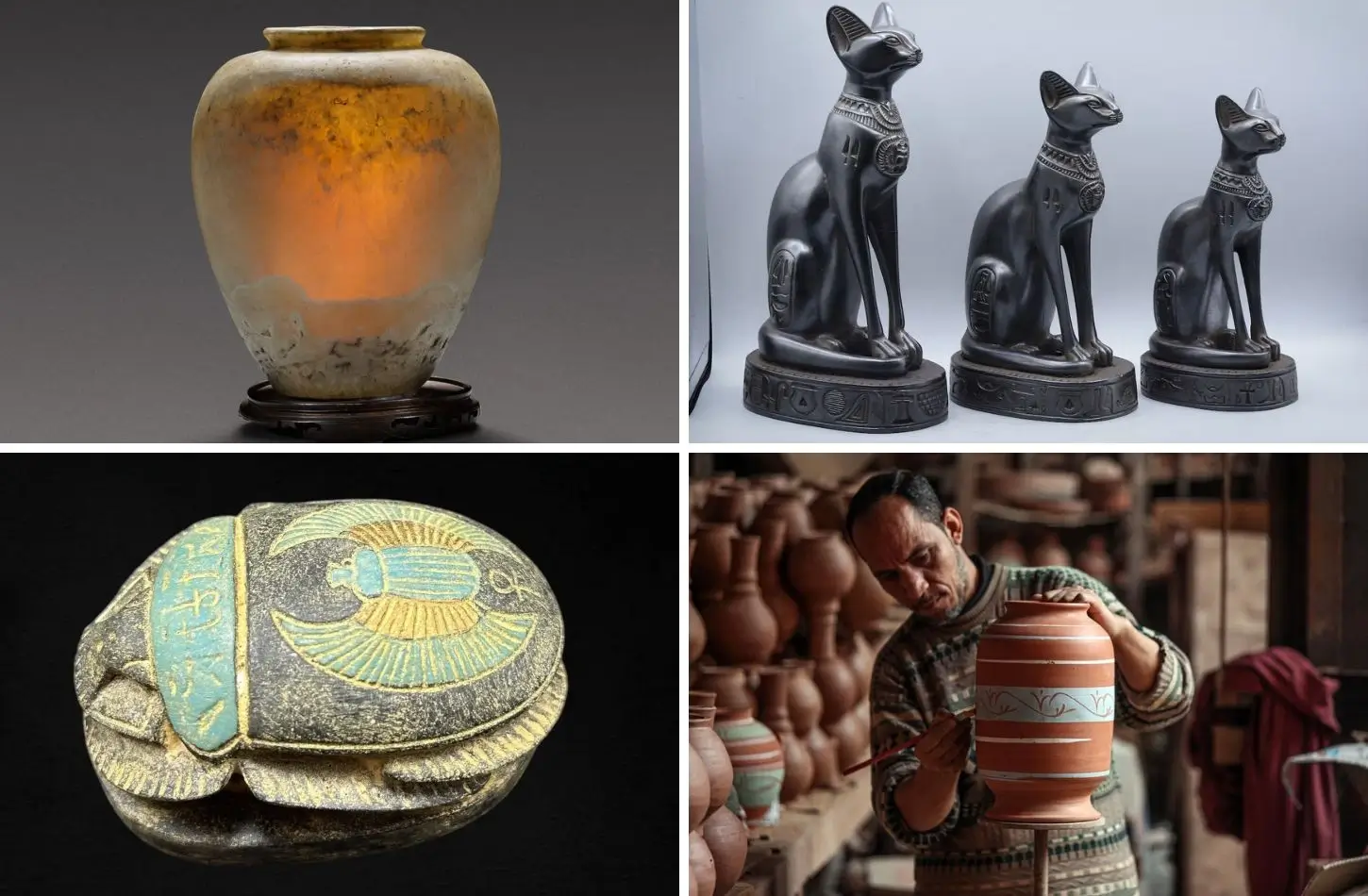
Authenticity check: Genuine kiln-fired pottery has a slight roughness on unglazed base sections. Inspect for hand-painted variation in glaze lines.

Copper, brass & metalwork
12- Hand-engraved copper tray
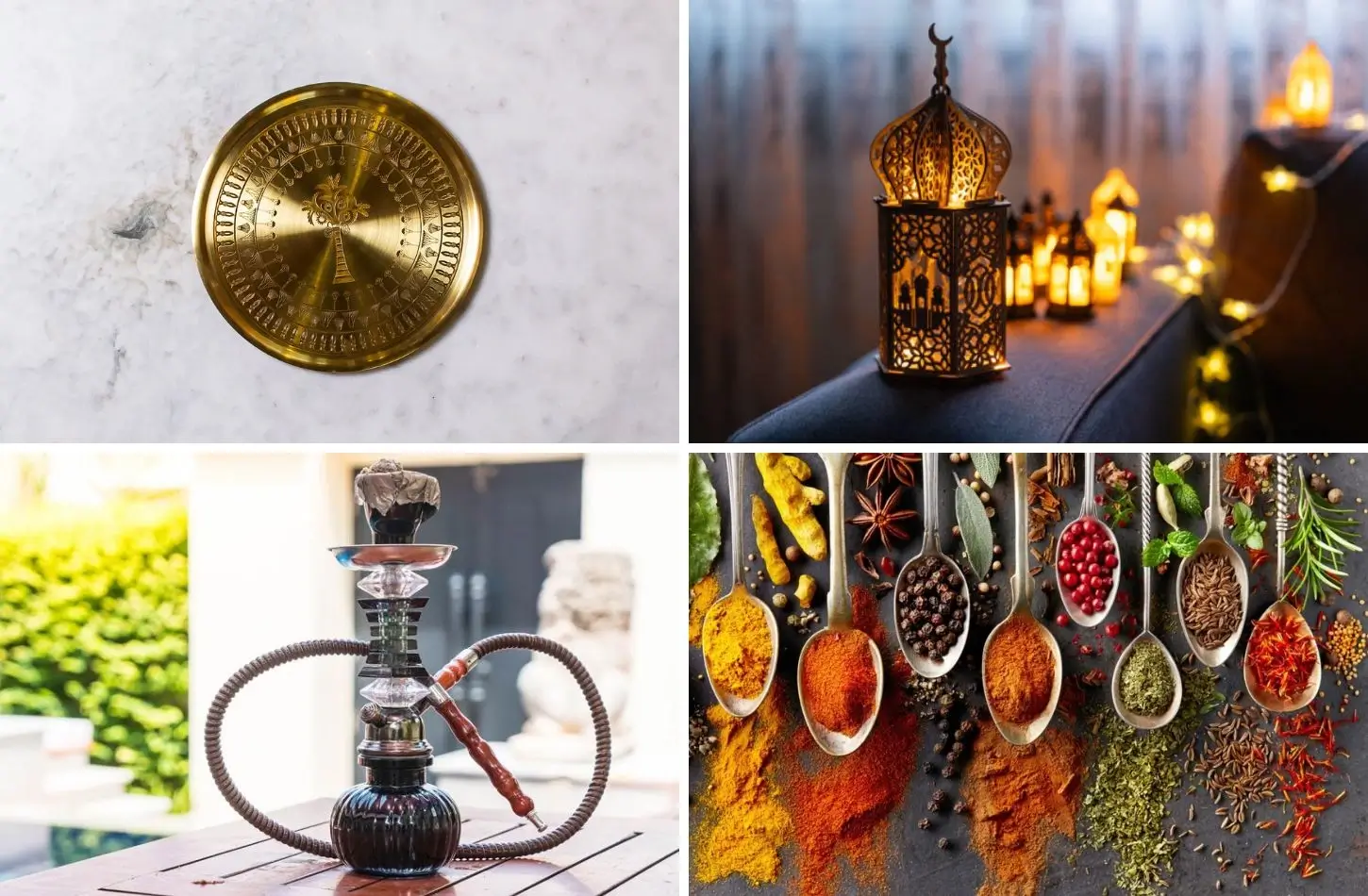
Copper trays with intricate geometric or calligraphic engraving are classic Egyptian craft objects that serve a function: used in every Egyptian home as serving trays and coffee tables. A hand-engraved tray is one of the few souvenirs that will still look good in your home in 20 years.
Price: EGP 300–800 ($6–$16) small (30cm) | EGP 800–2,000 ($16–$41) medium (50cm) | EGP 2,000–6,000 ($41–$122) large (70cm+, engraved)
Where to buy: Coppersmith Lane, Khan El-Khalili; Old Cairo workshops
Authenticity check: Hand-engraved trays have irregular chisel marks at close inspection. Machine-pressed trays have perfectly uniform, shallow patterns.
13- Ramadan lantern (fanoos)
The fanoos is Egypt’s most beloved Ramadan symbol — hung in every home and street the moment the crescent moon is sighted. Brass lanterns with geometric cutwork cast extraordinary shadow patterns when lit; coloured-glass fanoos fill a room with warm, jewel-toned light. Both are handmade by craftsmen in El-Ghouria who have kept this tradition alive since the Fatimid era.
Price: EGP 200–600 ($4–$12) small brass | EGP 600–1,800 ($12–$37) medium coloured glass | EGP 1,800–5,000 ($37–$102) large hand-crafted brass
Where to buy: El-Ghouria Market (Islamic Cairo), specialist lantern workshops, Al-Azhar area
Authenticity check: Tap the brass body — a clear metallic ring = genuine brass. A dull thud = tin or aluminum. Glass panels should have slight hand-cut irregularities; perfectly uniform panels = plastic.
14- Shisha pipe (hookah)
A decorative shisha pipe is one of Egypt’s most culturally specific souvenirs — central to Egyptian social life for centuries. Quality pipes are made of blown glass, brass, and hardwood; they function as display pieces even if you never smoke them.
Price: EGP 300–700 ($6–$14) basic functional | EGP 700–2,000 ($14–$41) mid-quality | EGP 2,000–6,000 ($41–$122) premium artisan
Where to buy: Al-Azhar Street specialist shops (Cairo), Khan El-Khalili
Authenticity check: Check the grommet seal between the bowl and stem. A tight seal = functional quality.
Fragrances, spices & food
15- Perfume oils & incense burner (mabkhara)
Egypt’s fragrance tradition runs deep — from the concentrated essence oils blended in Khan El-Khalili’s Perfume Alley to the handcrafted brass burners used in every Egyptian home daily. Buy them together: a 30ml bottle of oud or amber oil and a mabkhara to burn bakhour resin, and you’ll bring home an entire sensory experience. The oils are significantly stronger and longer-lasting than Western eau de parfum; the burners double as decorative pieces even when not in use.
Price (oils): EGP 150–400 ($3–$8) 10ml | EGP 400–1,000 ($8–$20) 30ml | EGP 1,000–3,500 ($20–$71) premium oud/ambergris
Price (burner): EGP 150–400 ($3–$8) small | EGP 400–1,200 ($8–$24) medium | EGP 1,200–3,500 ($24–$71) large decorative
Where to buy: Perfume Alley, Khan El-Khalili (Cairo); Al-Hussein area shops; Aswan Souk
Authenticity check (oils): Apply to skin and wait 2 minutes. Real essence holds and evolves. Diluted oil fades within 10 minutes.
Authenticity check (burner): Weight test — brass is substantially heavier than tin. A light burner that looks like brass is tin-plate coated.
Nada’s tip
The best prices for crafts and fragrances come from going directly to the source — the Fustat kilns for pottery, the coppersmith lane for trays, the El-Ghouria workshops for lanterns, and Perfume Alley for oils. Every one of these is within a short detour of the main tourist route. A 20-minute walk off the beaten path saves 40–60% and gets you a better piece.
16- Spice blends (karkade, dukkah, cumin, coriander)
Egyptian spices — particularly karkade (dried hibiscus for tea), dukkah (the nut-herb-spice blend eaten with bread), and loose cumin — are available in quality far superior to supermarket imports, and at a fraction of the price. All pass through customs without issue.
Price: EGP 50–150 ($1–$3) 100g bag | EGP 150–400 ($3–$8) gift box set | EGP 400–900 ($8–$18) premium saffron (verify it’s real — see below)
Where to buy: Aswan Spice Market, Khan El-Khalili spice section (Cairo), Luxor bazaar
Authenticity check: Saffron should be deep-red threads that release a yellow hue into water. Orange-red threads that color water red = safflower substitute (common scam). Smell it: real saffron has a distinctive metallic-honey smell.

Aswan’s spice market and Nubian craft workshops reward those who aren’t rushing. Our Aswan Tours give you the time to browse properly — or you can arrive by river on one of our Egypt Nile Cruises.
17- Egyptian dates (Siwa Medjool, stuffed varieties)
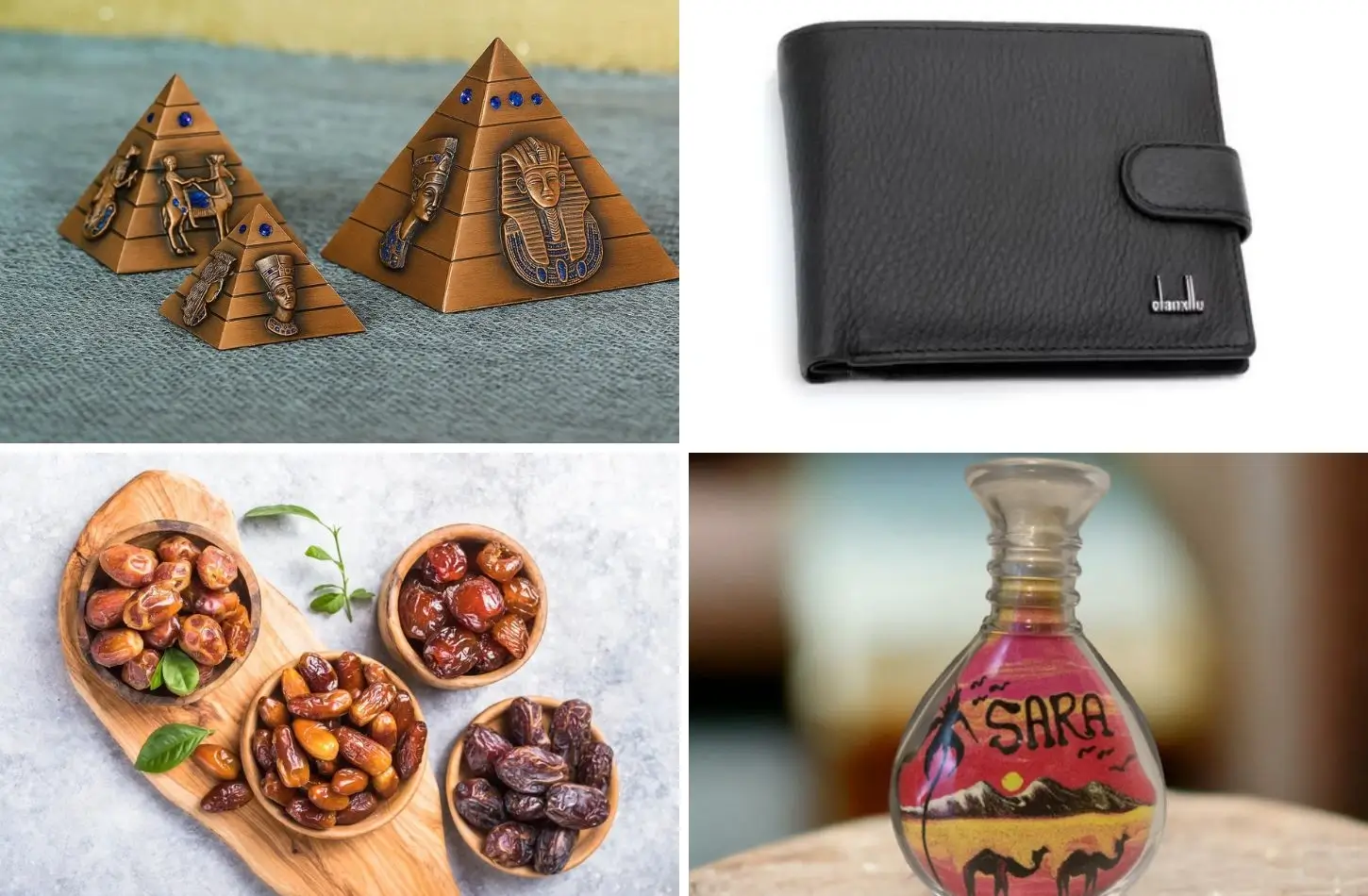
Egyptian dates — especially Siwa Medjool and the stuffed dates filled with walnuts, pistachios, or almond paste — are world-class. Vacuum-sealed packages travel well and pass through most customs declarations as agricultural food products (declare on arrival).
Price: EGP 80–200 ($1.60–$4) 500g loose | EGP 200–500 ($4–$10) 500g vacuum-sealed | EGP 500–1,200 ($10–$24) 1kg premium stuffed gift box
Where to buy: Date specialists in Ataba Market (Cairo), Siwa Oasis (if visiting), hotel delis (packaged only)
Authenticity check: Buy vacuum-sealed only for travel. Check the expiry date. Medjool dates should be plump and slightly shiny, not dry or wrinkled.
Art, paper & decorative
18- Sand art bottle
Layers of differently coloured desert sand, arranged into landscapes, camels, or geometric patterns inside a sealed glass bottle. These are lightweight, inexpensive, and genuinely handmade by artisans who spend years perfecting their technique. Look for bottles where the sand layers curve at the edges, rather than being flat horizontal lines.
Price: EGP 80–200 ($1.60–$4) small | EGP 200–500 ($4–$10) medium | EGP 500–1,200 ($10–$24) large artisan with inscription
Where to buy: Pyramid area vendors (Giza), Sinai markets (Sharm El-Sheikh, Dahab)
Authenticity check: Curved sand layers at the bottle edges = handmade. Perfect horizontal layers = machine-filled.
Leather & accessories
19- Leather sandals (handmade)
Traditional Egyptian leather sandals — made to measure in 30–60 minutes in the Khan El-Khalili leather workshops — are durable, comfortable, and genuinely unique. The leather is vegetable-tanned and embossed with Arabic calligraphy or pharaonic patterns on request.
Price: EGP 300–700 ($6–$14) pre-made | EGP 700–1,500 ($14–$31) made-to-order | EGP 1,500–3,000 ($31–$61) premium embossed
Where to buy: Leather workshops, Khan El-Khalili; Sanadiqiyya Street (Cairo)
Authenticity check: Genuine leather has a consistent smell and flexes without cracking. Synthetic leather has a plastic smell and cracks at seams when flexed.
20- Leather bag or wallet
Egyptian tanneries produce excellent quality goat and camel leather. Wallets, passport holders, and small bags made in the Old Cairo leather workshops are substantially better quality than tourist-facing products and available at local prices.
Price: EGP 200–500 ($4–$10) wallet | EGP 500–1,500 ($10–$31) small bag | EGP 1,500–4,000 ($31–$82) large bag
Where to buy: Leather district, Muski Gate area, Khan El-Khalili (Cairo); Alexandria leather workshops
Authenticity check: Check stitching at corners — it should be tight and consistent. Genuine leather pores are irregular under close inspection.
Nada’s tip
For anything edible, buy vacuum-sealed and check expiry dates. For leather, always test flexibility at the seams before buying — genuine leather flexes cleanly; synthetic cracks. And for anything that can be personalized — cartouches, sandals, bags — ask. The workshops almost always offer it, and it costs very little extra.
Home decor & miscellaneous
21- Egyptian carpet or kilim rug
Handwoven Egyptian kilim rugs feature bold geometric designs in natural dyes — they’re flat-woven and therefore lighter and easier to transport than knotted pile rugs. Smaller kilims (60x90cm) pack into a checked bag relatively easily.
Price: EGP 400–1,200 ($8–$24) small kilim | EGP 1,200–3,500 ($24–$71) medium | EGP 3,500–12,000 ($71–$245) large handwoven
Where to buy: Wekalet El-Balah Market (Cairo), carpet shops in Luxor West Bank, Alexandria
Authenticity check: Ask about the weave count — more knots per square cm = finer quality and higher price. Natural dyes show slight tonal variation; synthetic dyes are perfectly uniform.
22- Egyptian wool scarf
Handwoven woolen scarves from Upper Egypt and the Western Desert oases feature rich jewel tones and geometric patterns. Warm, lightweight, and genuinely useful abroad — a well-chosen scarf will be worn for years.
Price: EGP 150–400 ($3–$8) cotton/synthetic mix | EGP 400–1,000 ($8–$20) pure wool | EGP 1,000–2,500 ($20–$51) Siwa Bedouin camel wool
Where to buy: Khan El-Khalili (Cairo), Aswan souq, Siwa Oasis market
Authenticity check: Pull a few fibers from a discreet area and burn them: wool smells like hair and forms a crushable ash. Synthetic smells like plastic and forms a hard bead.

23- Miniature pyramid set (stone)
Miniature pyramid replicas in alabaster, basalt, or polished granite are among Egypt’s most iconic souvenirs. Small sets of three (representing Khufu, Khafre, and Menkaure) are widely available and make excellent desk or shelf displays.
Price: EGP 100–300 ($2–$6) small plaster/resin set | EGP 300–800 ($6–$16) medium stone | EGP 800–2,500 ($16–$51) premium alabaster/basalt
Where to buy: Grand Egyptian Museum shop (Giza), pyramid area vendors (negotiate hard)
Authenticity check: Tap the pyramid: stone makes a solid sound. Plaster makes a hollow tap. Drop water on it: stone stays cool; plaster warms slightly.
Nada’s tip
For textiles and stone pieces, the burn test and tap test are your best friends — wool smells like hair, cotton like paper, synthetic like plastic; stone rings clearly, plaster thuds. If you’re unsure about any decorative piece, the Konouz EG stall at the Grand Egyptian Museum is a reliable quality benchmark to calibrate against before shopping the open market.
2026 Cairo price reference table
All prices confirmed April 2026. EGP prices are at mid-market rates; tourist-facing shops near major attractions will be 30–60% higher. USD based on EGP 49 = $1 (April 2026).
| 🎁 Souvenir | 💰 Budget | ✨ Mid-range | 👑 Premium | 📍 Best Spot |
|---|---|---|---|---|
| 📜 Papyrus Art | $3–$12 | $12–$37 | $37–$163 | Khan El-Khalili |
| 🛏️ Cotton Bedding | $5–$12/pc | $16–$45/sheet | $51–$122/set | Wekalet El-Balah |
| 🏺 Alabaster Piece | $3–$10 | $10–$41 | $41–$163 | Luxor West Bank |
| 📿 Cartouche Pendant | $8–$20 (silver) | $20–$57 (large) | $71–$163+ (gold) | Khan El-Khalili Gold |
| 🪲 Scarab Amulet | $1–$4 | $6–$18 (silver) | $31–$92 (stone) | Luxor East Bank |
| 🟤 Copper Tray | $6–$16 (small) | $16–$41 (medium) | $41–$122 (large) | Coppersmith Lane |
| 🧴 Perfume Oil | $3–$8 (10ml) | $8–$20 (30ml) | $20–$71 (oud) | Perfume Alley, KK |
| 🌶️ Spice Set | $1–$3 (100g) | $3–$8 (gift box) | $8–$18 (saffron) | Aswan Spice Market |
| 👡 Leather Sandals | $6–$14 (pre-made) | $14–$31 (bespoke) | $31–$61 (embossed) | Sanadiqiyya St |
| 💍 Gold Jewelry | $16–$41 (silver) | $41–$122 (18K earr) | $122–$510+ (necklace) | Muski St, Azza Fahmy |
| 👘 Galabeya Robe | $4–$10 (plain) | $10–$31 (embroider) | $31–$82 (silk) | Al-Azhar Street |
| 🧵 Khayameya Textile | $6–$16 (cushion) | $16–$51 (hanging) | $51–$163 (panel) | Khayameya Street |
Where to shop: Khan El-Khalili vs. new bazaars vs. hotel shops
Where you buy matters as much as what you buy. Here’s an honest comparison of your options — based on what I’d recommend to a friend, not what earns a commission.
Khan El-Khalili (Cairo) — the essential stop
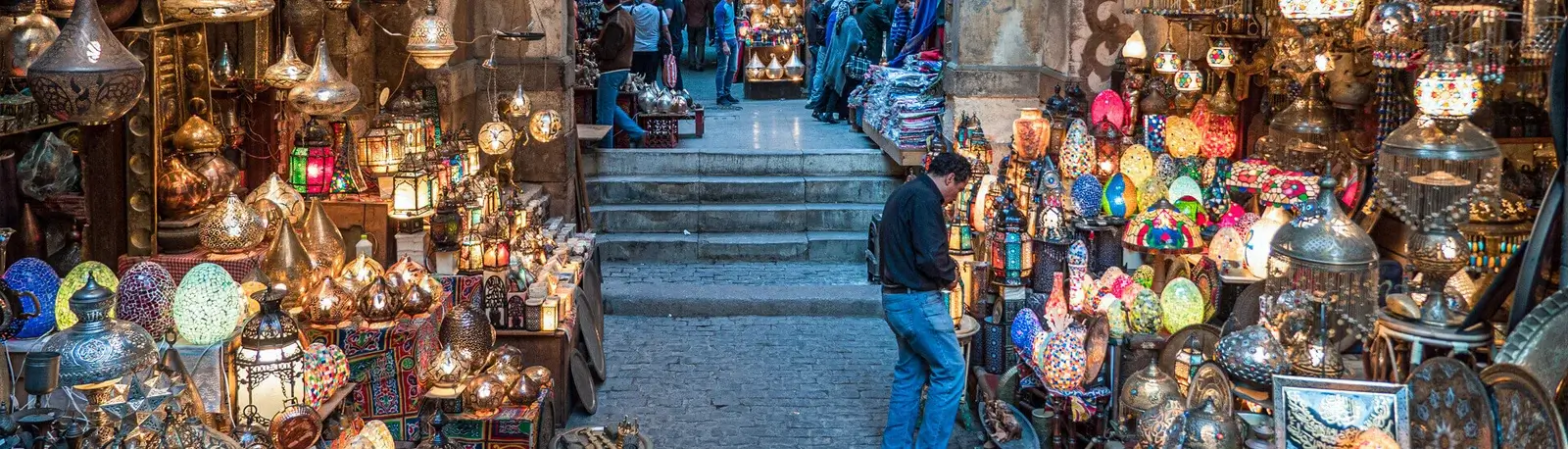
Founded in 1382 by the Mamluk emir Djaharks El-Khalili, Khan El-Khalili is one of the oldest continuously operating markets in the world (Al-Ahram archive, established 14th century). Today, it covers dozens of interconnected lanes in the heart of Islamic Cairo, specializing in gold, silver, perfume, papyrus, spices, and craft goods.
- Best for: Jewelry, papyrus, perfume oils, copper, spices, leather
- Bargaining: Expected and part of the experience. Start at 50% of the first quote.
- Avoid: The main tourist square immediately inside the gate — prices there are 40–60% higher than two streets back.
- Best hours: 9–11 am weekdays (craftsmen working, fewer tourists); avoid Fridays (reduced hours, busy).
Aswan Souk — best for spices, Nubian crafts, and relaxed shopping
Aswan’s main market runs along Shari’a as-Souq and is notably more relaxed than Cairo’s bazaars. The spice market is the finest in Egypt: fresher stock, wider variety, and significantly lower prices than in Cairo. The Nubian craft section has handwoven baskets, textiles, and woodwork you won’t find in the north.
- Best for: Spices, karkade, Nubian baskets and textiles, alabaster (from Luxor area vendors)
- Bargaining: Less aggressive than Cairo. Counter-offer politely; vendors here will meet you.
- Best hours: Early morning (7–9 am) for spice freshness; late afternoon for uncrowded browsing.
Luxor bazaar — best for alabaster, scarabs, and Upper Egypt crafts
Luxor has two main shopping areas: the East Bank tourist bazaar (higher prices, convenient) and the West Bank alabaster workshops and local market (lower prices, more authentic). The West Bank is where I send everyone for stone work.
- Best for: Alabaster carvings, scarab amulets, Saidi galabeyas, papyrus
- West Bank workshops: Buy directly from the carver and watch the process. No markup for the shop intermediary.
Hotel shops and museum gift shops — when to use them
Hotel shops charge a premium of 100–300% over market prices. The quality is often no better than what’s available in the market, and items may be mass-produced rather than handmade. The exception: the Grand Egyptian Museum’s Konouz EG shop, which sells Ministry of Tourism-certified replica sculptures at fixed, transparent prices. If you want a certified replica that you can’t authenticate yourself, this is the right choice.
- Use hotel shops for Last-minute gifts when you have no time, or if mobility makes shopping at the market difficult.
- Use GEM (Konouz EG) for: Certified replica sculptures, pharaonic statues, and museum-quality pieces.
- Avoid hotel shops for Papyrus, jewelry, spices, and perfume—the markup is not justified by the quality.
5 things tourists overpay for — and what to buy instead
These are the most common tourist traps in Egypt’s markets
Not because vendors are dishonest — but because certain items have acquired a tourist price that bears no relation to local value. Here’s what to skip and what to swap.
1- Fake saffron — buy karkade instead
Saffron is the most-scammed spice in Egypt’s markets. What’s sold as saffron is usually safflower (a red-orange flower that colors food but has none of saffron’s flavor or medicinal properties) at near-saffron prices. Real saffron costs EGP 800–1,500 per gram and should only be bought from verified pharmacies or specialist spice merchants who can show provenance.
Buy instead: Karkade (dried hibiscus flowers). Makes a brilliant deep red tea, hot or cold, rich in antioxidants, genuinely Egyptian, EGP 50–120 per 100g, and impossible to fake.
2- Banana-leaf ‘papyrus’ — buy genuine papyrus or skip it
A significant proportion of papyrus sold in tourist areas is made from banana leaves or pressed card, not from the papyrus plant. It looks similar and costs the same. The roll test (see above) identifies it instantly. A banana-leaf scroll will crack and discolor within months; genuine papyrus lasts thousands of years.
Buy instead: Spend the same money (EGP 300–600) at the Pharaoh’s Papyrus Institute in Giza for a certified, genuine piece. Or buy a set of postcards from a reputable dealer — small but real.
3. Hotel-lobby perfume oils — buy from Perfume Alley instead
Perfume oils sold in hotel lobbies and near major tourist sites are typically heavily diluted and packaged in fancy bottles to justify a premium. A 30ml bottle that costs EGP 800 in a hotel sells for EGP 200–300 in Khan El-Khalili’s Perfume Alley with better fragrance concentration.
Buy instead: The same oils from Perfume Alley, after doing the 2-minute skin test to confirm concentration.
4. Plaster pharaoh statues at Pyramid souvenir stalls — buy stone from Luxor
The souvenir stalls immediately outside the Giza Pyramid complex are among the most aggressively priced in Egypt, and the quality of most painted plaster statues is poor — they chip easily, and the paint fades. The location premium you pay there is substantial.
Buy instead: A stone or alabaster version from the West Bank workshops in Luxor, or a Konouz EG certified piece from the Grand Egyptian Museum shop (also in Giza, 10 minutes from the Pyramids).
5. Tourist-facing Khan El-Khalili ‘front square’ shops — go two streets deeper
The shops immediately inside Khan El-Khalili’s main Muski gate are oriented almost entirely towards tourists and price accordingly. The same items — papyrus, jewelry, copper, scarves — are available at 30–60% lower prices in the workshops and family shops two to three streets further into the bazaar.
Buy instead: Walk past the first 50m of stalls. Turn into any of the side alleys and ask for the craftsmen’s section. You’ll hear hammering, smell leather, and find completely different prices.
Customs and shipping: what you can take home
Egypt has strict rules about exporting antiquities. Modern souvenirs are not affected, but there are important category-specific rules for your destination country. Here’s what you need to know before you buy.
⚠ Egyptian export law: never buy real antiquities
It is illegal to export any genuine antiquity from Egypt — this includes items that appear old. All souvenirs must be modern reproductions. If a vendor claims an item is genuinely ancient, do not buy it: you risk confiscation and criminal charges under Egyptian Law 117/1983. Source: Egyptian Ministry of Tourism and Antiquities.
United Kingdom
- Papyrus and alabaster: No restrictions. Declare a value over £390 on arrival.
- Food items (dates, spices): Generally permitted in small personal quantities. Declare at customs. UK Border Force advises declaring all food products; non-commercial quantities of plant-based spices and dried fruit are typically cleared without issue.
- Textiles and leather: No restrictions. VAT may apply to commercial quantities.
- Gold and silver: Declare at customs if the total value of jewelry exceeds £390. Duty-free allowance applies to personal items.
- Ivory: Banned from import into the UK under CITES. Do not buy ivory products in Egypt.
United States
- Papyrus and alabaster: No restrictions. Declare value over $800 on CBP Form 6059B.
- Food items (dates, spices): Declare all food on CBP Form 6059B. Commercially packaged, sealed spices and dried dates are generally permitted. Fresh dates without pits may require USDA
- inspection. Loose, unpackaged food may be confiscated. Source: U.S. Customs and Border Protection.
- Textiles: No restrictions on personal quantities.
- Gold and silver: Declare if the total value exceeds the $800 personal exemption.
- Ivory: Banned. Subject to CITES and ESA enforcement.
Australia
- Food items (spices, dried dates): Australia has the strictest biosecurity rules in this group. All food must be declared on your Incoming Passenger Card. Commercially packaged, heat-treated spices are generally permitted. Undeclared food can result in AU$630 on-the-spot fines. Declare everything and let biosecurity decide.
- Papyrus, alabaster, textiles, jewelry: No restrictions beyond general duty-free limits (AU$900 personal exemption).
- Ivory: Banned.
UAE
- Papyrus, alabaster, textiles, ceramics: No restrictions.
- Food (dates, spices): No restrictions on commercially sealed products.
- Gold and silver: Declare jewelry at Dubai Customs if the value exceeds AED 3,000 (approx. $820). Commercial quantities require import permits.
- Shisha pipes: Legal to import for personal use. Tobacco products subject to standard UAE excise duties.
Frequently asked questions
What is the best souvenir from Egypt?
The best Egypt souvenirs combine authenticity, practicality, and cultural meaning. Our top picks are: genuine papyrus art (roll test to verify), Egyptian cotton products (look for the hologram sticker), hand-carved alabaster from Luxor workshops, personalized silver cartouche jewelry, and concentrated perfume oils from Khan El-Khalili’s Perfume Alley. For food: karkade tea, dukkah spice blend, and vacuum-sealed Medjool dates all travel well and clear customs in the UK, US, Australia, and UAE.
How much should I spend on Egyptian souvenirs?
A reasonable souvenir budget for a one-week trip to Egypt is $50–$150 USD per person, which covers a mix of gifts (papyrus bookmarks, spice sets, small scarabs) and one or two personal pieces (a silver cartouche, a perfume oil, an alabaster piece). If you’re buying gold jewelry or large alabaster sculptures, budget $100–$300 per item. All prices are negotiable in markets — start at 50% of the first quote and expect to settle at 60–70%.
What is the most bought souvenir from Egypt?
Papyrus art is consistently the most bought souvenir in Egypt — it’s widely available, lightweight, and immediately recognizable as Egyptian. Close behind are scarab amulets, miniature pyramids, and perfume oils. Among food souvenirs, spice sets and karkade (dried hibiscus) are the most frequently purchased, particularly by travelers looking for something practical to bring home.
What souvenirs are worth buying from Egypt?
The souvenirs most worth buying are the ones that combine authenticity, durability, and genuine local craftsmanship. Our top picks: a hand-painted papyrus scroll (verified with the roll check), a personalized silver cartouche pendant, concentrated perfume oils from Khan El-Khalili’s Perfume Alley, hand-carved alabaster from Luxor’s West Bank workshops, and Egyptian cotton products with the official hologram sticker. These are items that will still look and feel special years after your trip — unlike mass-produced plaster statues or fake saffron, which are widely available but poor value.
Are souvenirs cheaper at Khan El-Khalili or hotel shops?
Khan El-Khalili is significantly cheaper than hotel shops — typically 50–200% cheaper for the same item. Hotel shops charge a convenience and certainty premium; the quality is rarely superior. The exception is the Grand Egyptian Museum’s Konouz EG shop, which sells Ministry of Tourism-certified replica sculptures at fair, fixed prices — worth it if you want a guaranteed authentic reproduction without authenticity testing. For everything else, buy from markets and apply the authenticity tests in this guide.
Can I take papyrus and alabaster through UK and US customs?
Yes, with no restrictions. Both papyrus and alabaster are mineral or plant-derived decorative items with no import restrictions in the UK, US, Australia, or UAE. No declaration is required unless the total value of your souvenirs exceeds your duty-free allowance (£390 UK, $800 US, AU$900 Australia). The important rule is that items must be modern reproductions, not genuine antiquities — exporting real antiquities from Egypt is illegal under Egyptian law and may result in confiscation by the customs authorities of your destination country.
If this guide has you thinking about the trip itself, our Egypt Day Trips and Egypt Travel Packages are a good place to start — built around the same local knowledge that went into this article.
Final note from Nada
Egypt’s markets are not just places to buy things. They’re living institutions — Khan El-Khalili has been continuously trading since the 14th century, and the craftsmen working the copper lane have learned their trade from their fathers and grandfathers. When you buy something handmade, you’re participating in that chain.
Take your time. Let yourself get a little lost in the alleys. Ask a vendor where they learned their craft — the stories you hear will mean as much as the things you bring home.
If you’re traveling with Tripianto, our guides can take you directly to the craftsmen we trust — no tourist markup, no pressure. Ask your guide to include the Khan El-Khalili workshop route in your Cairo day.