


published: June 2026
Quick Answer
❓What is the Temple of Hatshepsut and why should you visit?
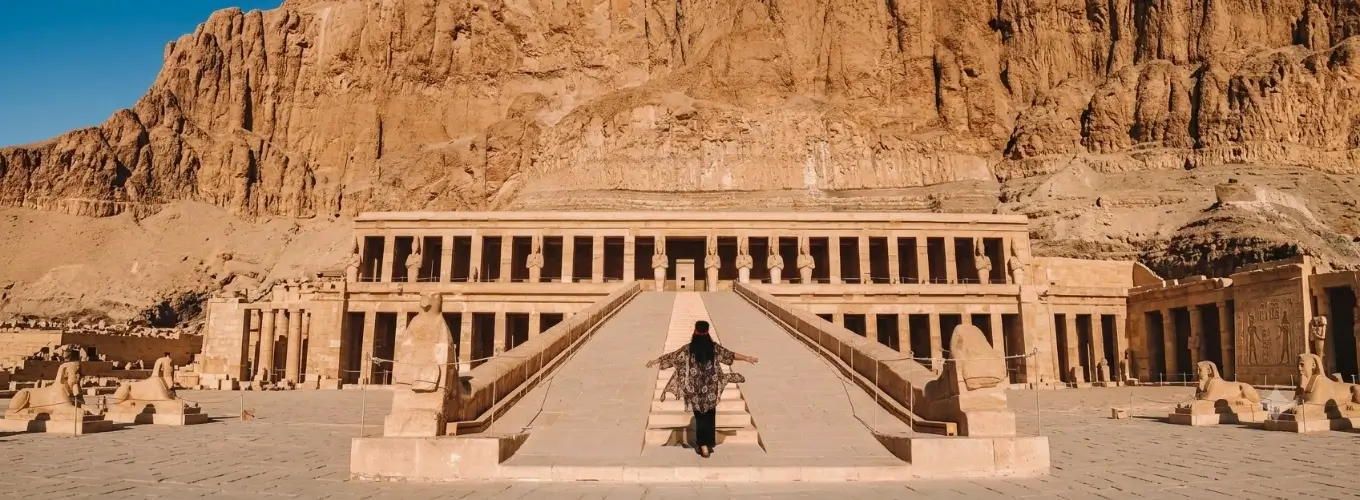
Built by Egypt’s most powerful female pharaoh around 1458 BC, the Temple of Hatshepsut at Deir el-Bahari is one of the ancient world’s greatest architectural masterpieces — three dramatic colonnaded terraces rising against golden limestone cliffs on Luxor’s West Bank.
🏛️ Arrive at 6 AM
beat the crowds and catch the temple in the best morning light before tour buses arrive
🎟️ Tickets cost 440 EGP
card payment only, no cash accepted at the main booth
👟 Wear grip shoes & a hat
limestone ramps are slippery and terraces have zero shade
🗺️ Pair it with Valley of the Kings
both sites are West Bank neighbours, perfect for one full day
Picture this: you step off the electric tram and the entire Theban cliff face opens before you — three pale terraces rising in perfect geometry against raw golden limestone. No sound except dry air. This is the Temple of Hatshepsut at Deir el-Bahari, and it stops visitors in their tracks every single morning.
Of all the monuments on Luxor’s West Bank, none carries a story quite like this one. Egypt’s most powerful female pharaoh built the Temple of Hatshepsut not just as a tomb, but as a declaration carved into the mountain itself — so that no one, not even history, could erase her. (Someone tried. They failed.) Today, the Temple of Hatshepsut draws travellers who come for ancient history and leave with something they didn’t expect: a quiet, bone-deep sense of wonder.
This guide covers everything you need before you go — who Hatshepsut was, what you’ll see inside, ticket prices, the best time to visit, and how to combine it with the rest of the Luxor West Bank in one unforgettable day.
Who Was Hatshepsut? Egypt’s Most Remarkable Female Pharaoh
To truly understand the Temple of Hatshepsut, you must first understand the extraordinary woman who built it. In a civilisation that had been ruled by men for nearly 1,500 years, Hatshepsut not only seized power — she ruled for over two decades as one of Egypt’s most prosperous and ambitious pharaohs.
Early Life and Rise to Power
Hatshepsut was born around 1507 BC as the daughter of Pharaoh Thutmose I, one of Egypt’s greatest military rulers. She was educated as a royal child, steeped in court ritual and statecraft. When Thutmose I died, her half-brother and husband Thutmose II ascended the throne, with Hatshepsut serving as Great Royal Wife. When Thutmose II died — likely in his early 30s — around 1479 BC, the heir to the throne was his son Thutmose III, born of a lesser wife. Because Thutmose III was still a young child, Hatshepsut was appointed regent to govern on his behalf. But within a few years, she made an audacious move: she crowned herself pharaoh of Egypt, adopting the full royal regalia including the double crown, crook, flail, and ceremonial false beard — a transformation so absolute it makes the story of her rise one of the most compelling chapters you can explore on any Egypt Short Break, whether you have three days in Luxor or a week along the Nile. She became not just a female ruler, but a pharaoh in every sense — divine, absolute, and eternal.
What Made Her Reign So Remarkable?
During her approximately 22-year reign (c. 1479–1458 BC), Hatshepsut achieved what many male predecessors had not. She was a builder-pharaoh of the first order, commissioning more monuments, temples, and statues than any Egyptian ruler up to that point. Karnak Temple, one of the greatest religious complexes ever built, was expanded dramatically under her reign — she erected two pairs of obelisks, the largest ever built at the time. But she was also a trader and diplomat. Her most celebrated achievement — depicted in vivid detail on the walls of her mortuary temple — was the legendary expedition to the Land of Punt, a wealthy and mysterious trading partner believed to be located somewhere along the coast of modern-day Somalia, Eritrea, or Yemen. Her ships returned laden with myrrh trees, ebony, gold, ivory, and exotic animals. It was a triumph of soft power, enriching Egypt without a single battle — the kind of story that makes Luxor an unmissable stop on any Egypt Travel Package, from classic week-long itineraries to extended Nile journeys. Hatshepsut was also deeply devout. She saw herself as the daughter of Amun, the supreme god of the New Kingdom, and structured her reign and her monuments around this divine claim. The Temple of Hatshepsut was her ultimate expression of this identity: a building built for eternity, to honour the gods and secure her legacy in the afterlife.
Architecture of the Temple of Hatshepsut: A Masterpiece of Ancient Design
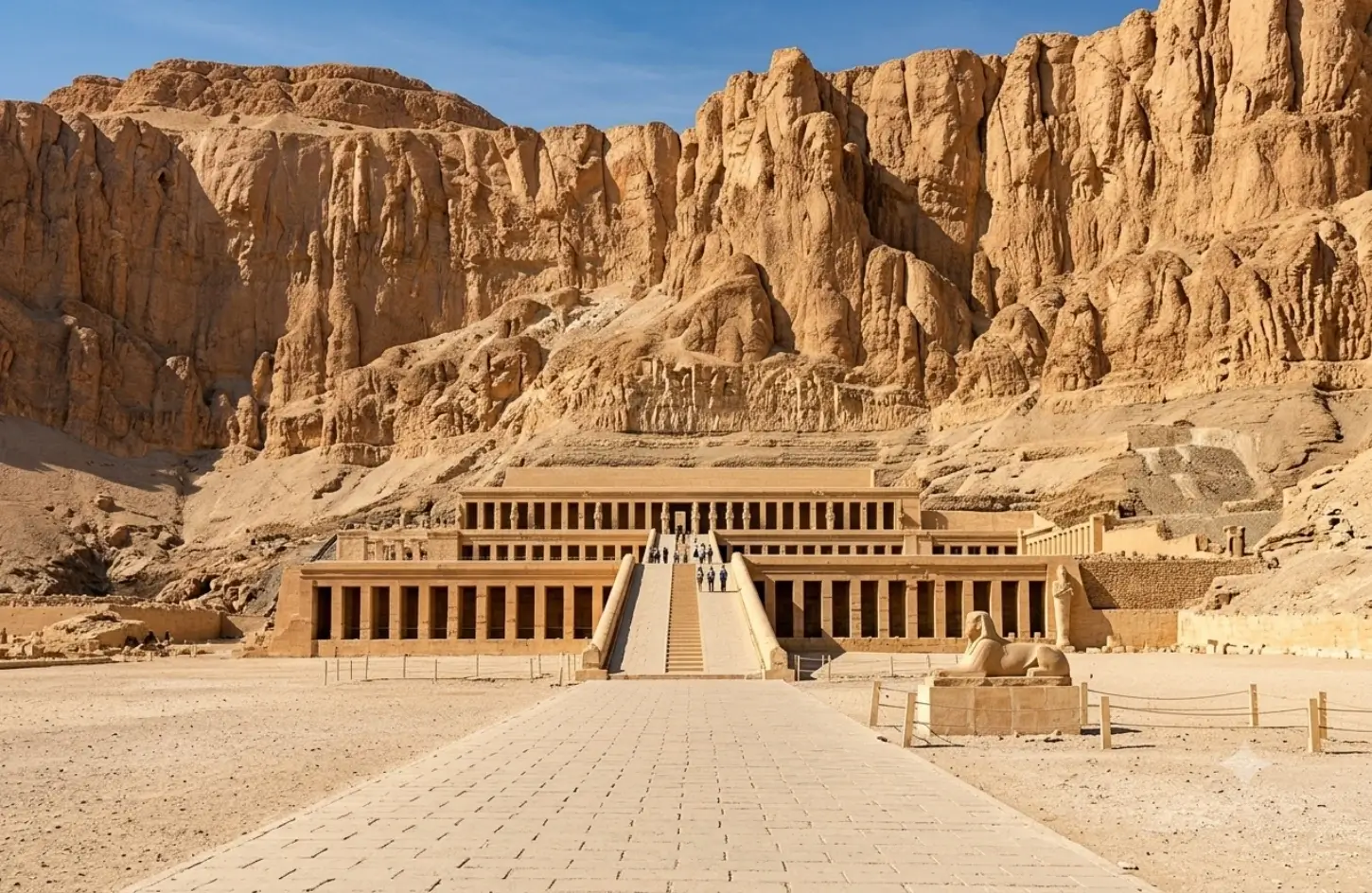
The Temple of Hatshepsut at Deir el-Bahari is considered one of the finest examples of ancient Egyptian architecture ever built. Unlike the massive pylons and enclosed courtyards of most Egyptian temples, Hatshepsut’s mortuary temple broke with convention — a bold, horizontal structure of colonnaded terraces that echoed the natural cliffs behind it in perfect geometric harmony.
Her chief architect, Senenmut, conceived a design entirely unlike anything built before. Three broad terraces rise one above the other, connected by long ramps, with each level supported by double rows of square limestone columns. The effect is both monumental and elegant — gravity-defying in its simplicity, set against the golden-ochre cliffs as if it grew organically from the desert itself.
The Three Terraces — A Guided Walk
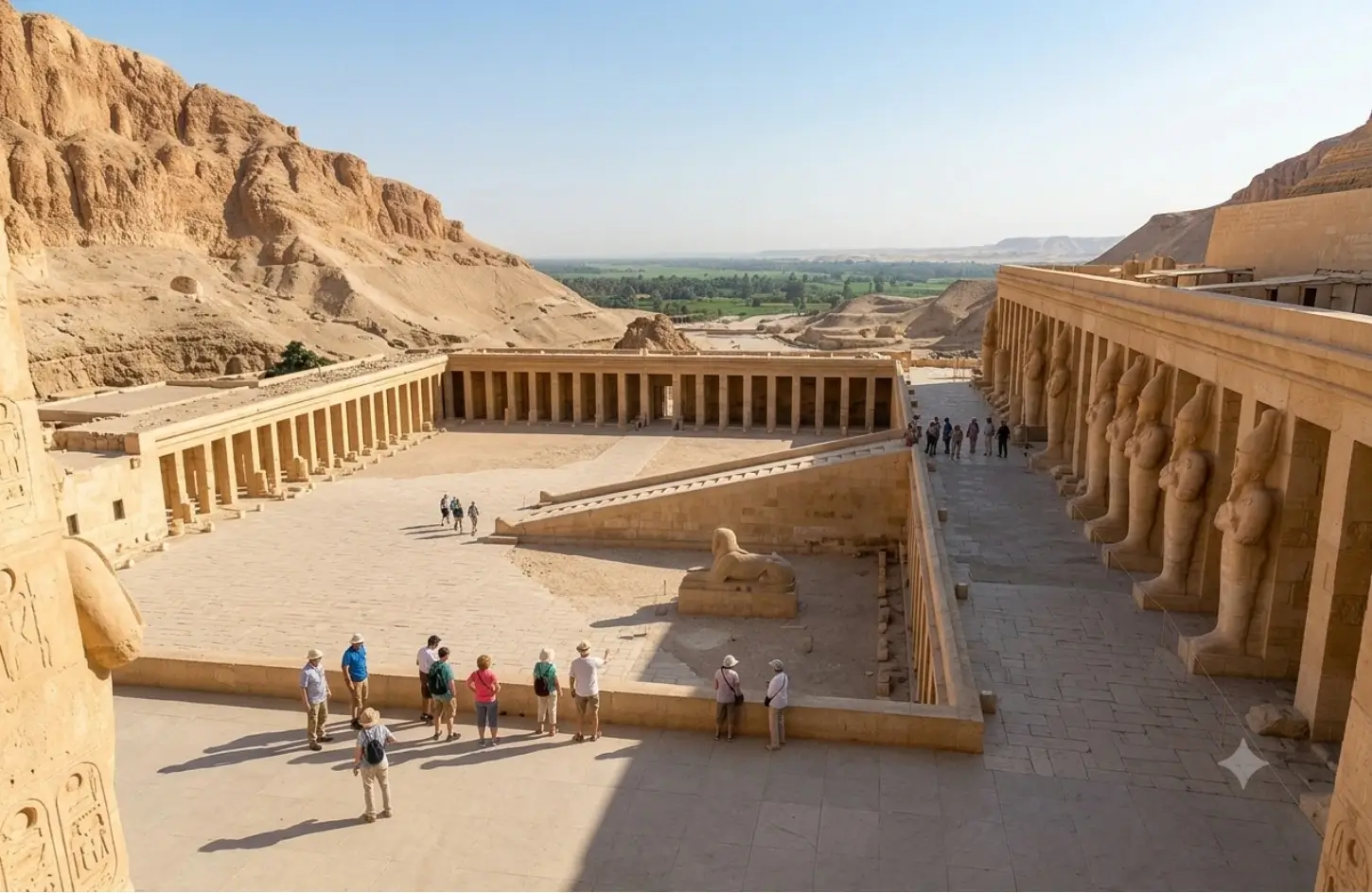
The temple is accessed from the east via a long processional causeway — originally lined with sphinxes bearing Hatshepsut’s face — that connected to the Nile valley below. Today visitors approach along a broad modern path before ascending into the monument itself.
Lower Terrace: The first and largest terrace served as an entrance court, once planted with fragrant myrrh trees transplanted directly from Punt. Today little remains of the original planting, but the foundations of the tree pits are still visible. Twin ramps with central stairways lead upward. The lower colonnade walls were once decorated with vivid painted reliefs showing Hatshepsut’s divine birth.
Middle Terrace: This level contains the most celebrated reliefs in the temple — the famous Punt Expedition scenes on the south colonnade, and the divine birth narrative on the north colonnade. Here Hatshepsut had depicted, in extraordinary detail, the story of her miraculous conception as the daughter of the god Amun himself. Two additional shrines are accessed from this terrace: the Chapel of Anubis (north) and the Chapel of Hathor (south).
Upper Terrace: The sacred inner sanctum, originally accessible only to priests. The main sanctuary was dedicated to Amun and aligned to receive sunlight at dawn during the winter solstice. Additional sanctuaries to Ra-Horakhty and Hatshepsut’s own deified image were also built here. The upper terrace was partly converted into a Coptic Christian monastery — Deir el-Bahari literally means ‘Northern Monastery’ — during the 6th century AD, which actually helped preserve many of its walls from later robbers.
The Chapel of Hathor
The Chapel of Hathor, accessible from the south end of the middle terrace, is one of the most beautifully preserved shrines in the entire temple. Its hypostyle hall is lined with Hathor-headed columns — capitals carved as the face of the cow-eared goddess of love, beauty, and music — and the walls still bear traces of their original polychrome paint in extraordinary condition. The level of preservation here is precisely what draws discerning travellers seeking Luxury Egypt Tours to linger far longer than any itinerary suggests. The chapel also contains images of Senenmut, Hatshepsut’s architect (and possible close companion), hidden behind door jambs — a subtle self-insertion into eternity.
The Chapel of Anubis
On the north side of the middle terrace, the Chapel of Anubis — god of embalming and the afterlife — retains some of the finest painted reliefs in any Egyptian temple. The colours here are startling in their vibrancy: deep blue faience ceiling tiles, crimson and ochre figures against white-washed walls. Scenes show Hatshepsut making offerings to Anubis and Amun in the presence of Thutmose III, reflecting the official co-regency fiction maintained in public art.
The Punt Expedition Reliefs: Ancient Egypt’s Greatest Trading Mission
If there is one story that defines the Temple of Hatshepsut above all others, it is the Punt Expedition — and its depiction on the walls of the middle terrace is one of the most extraordinary narrative reliefs in all of Egyptian art. In panel after panel, arranged in sequential scenes like an ancient graphic novel, the full story of Hatshepsut’s famous trading mission to the Land of Punt unfolds with astonishing documentary detail.
What Was the Land of Punt?
Punt was a legendary trading partner of ancient Egypt, known to Egyptians as ‘Ta Netjer’ — the ‘Land of the God.’ It was thought to be the original homeland of the gods, a sacred, fragrant, distant land beyond the horizon. Egyptian expeditions had traded with Punt since at least the 4th Dynasty (c. 2600 BC), but none had done so with Hatshepsut’s ambition or impact.
The exact location of Punt remains a scholarly debate. The most widely accepted theory places it somewhere along the Horn of Africa — in modern-day Eritrea, Djibouti, Somalia, or northern Ethiopia — though some scholars argue for the Arabian Peninsula coast of modern Yemen. The reliefs at Deir el-Bahari depict distinctive round huts on stilts, unusual trees, giraffes, and the tropical fauna of sub-Saharan Africa, which strongly support an East African location.
What the Reliefs Show
The Punt reliefs on the south colonnade of the middle terrace are arranged in horizontal registers that read left to right and document the entire expedition: the ships leaving Egypt, the arrival on the Punt coast, the trading exchange with the ruler of Punt (and his notably obese wife, shown in striking physiological detail), the loading of exotic goods onto the ships, and the triumphant return to Egypt.
Among the goods depicted being loaded: 31 living myrrh trees (successfully transplanted to the temple gardens), ebony, gold, ivory, animal skins, live baboons, greyhound dogs, and processed myrrh resin. The sheer specificity of the list — quantities, tree types, animal species — confirms the reliefs were intended as historical documentation, not mere decoration.
The Divine Birth Narrative: How Hatshepsut Claimed Divine Authority
On the north colonnade of the middle terrace, the Temple of Hatshepsut tells a story that is unique in Egyptian religious art: the miraculous conception and birth of Hatshepsut herself as the daughter of the god Amun. This north colonnade alone is reason enough to include Deir el-Bahari in any list of essential Egypt Day Trips from Luxor — no photograph or documentary fully prepares you for standing in front of these scenes in person. This ‘Divine Birth’ narrative was Hatshepsut’s masterstroke — a theological argument presented in stone and paint to justify her unprecedented rise to power as a female pharaoh.
The Story as Depicted in the Reliefs
The narrative begins with the god Amun, disguised as Thutmose I (Hatshepsut’s earthly father), visiting her mother Ahmose while she sleeps. The scenes show Amun, identifiable by his double-plumed crown, being led by the god Khnum (the divine potter) to the queen’s chamber. What follows is a conception scene — the god sitting knee-to-knee with the queen — depicted in symbolic rather than literal terms, surrounded by clouds of divine perfume.
Subsequent scenes show Khnum fashioning Hatshepsut and her ka (spiritual double) on his potter’s wheel. The goddess Hathor is shown presenting the infant Hatshepsut — already depicted in male royal dress — to Amun, who names her ‘Hatshepsut-Khnemet-Amun’ (United with Amun, Foremost of Noble Women).
The political genius of this narrative cannot be overstated. By embedding her own divine parentage into the very walls of her mortuary temple, Hatshepsut created an eternal visual argument: she was pharaoh not because she seized power, but because Amun himself willed it.
The Erasure of Hatshepsut: Why Her Image Was Destroyed
Walk through the Temple of Hatshepsut today and you will notice something disturbing: in hundreds of relief carvings throughout the complex, a figure has been systematically chiselled out. Faces scratched away. Names hacked from cartouches. Statues beheaded and buried in a great pit in the temple’s forecourt. This was a deliberate, systematic programme of erasure — and one of the most famous acts of political image destruction in the ancient world.
Thutmose III and the Campaign Against Hatshepsut’s Memory
For generations, scholars assumed the erasure was ordered immediately after Hatshepsut’s death by a resentful Thutmose III, finally free to avenge his decades of subordination. But modern Egyptological research — including work by scholars at the Metropolitan Museum of Art — has overturned this theory. The erasure did not begin until approximately 20 years after Hatshepsut’s death, near the end of Thutmose III’s own reign.
The more likely motivation was dynastic succession planning. Thutmose III was preparing to hand power to his son Amenhotep II and needed to ensure the line of male succession was clear and unambiguous. Hatshepsut’s existence — a woman who had ruled as pharaoh — complicated that narrative. Her erasure was less about personal revenge and more about political tidiness.
What Was Destroyed — and What Survived
The programme of destruction was thorough but not total. Statues were removed and buried (where they were discovered in 1926 in the ‘Hatshepsut Pit’ by the Metropolitan Museum). Images in accessible areas were defaced. But many reliefs in less-visible locations — on ceilings, in back chapels, on high registers — were left untouched and survive in extraordinary condition today.
It is through these surviving images, along with inscriptions, stelae, and the 200+ statues recovered from the Hatshepsut Pit, that Egyptologists have been able to reconstruct the full story of her reign. Today those statues — sphinxes, kneeling figures, seated statues in red granite and limestone — are among the prized possessions of the Metropolitan Museum of Art in New York and the Egyptian Museum in Cairo.
Best Time to Visit the Temple of Hatshepsut
Planning your visit to the Temple of Hatshepsut requires attention to Luxor’s extreme climate. The right timing transforms the experience; the wrong time can be physically punishing.
| MONTHS | TEMP (°C) | CROWDS | CONDITIONS | VERDICT |
|---|---|---|---|---|
| Oct–Nov | 22–32°C | Moderate | Cooling temps, pleasant mornings | ✅ Best overall |
| Dec–Feb | 12–22°C | Peak | Cool, sometimes cold mornings | ✅ Great — book ahead |
| Mar–Apr | 18–30°C | Moderate | Warming but comfortable | ✅ Good choice |
| May–Jun | 28–42°C | Low | Hot; early morning only | ⚠️ Manageable at 6am |
| Jul–Sep | 38–48°C | Very low | Extreme heat; taxing conditions | ❌ Avoid unless necessary |
Tip: No matter what month you visit, aim to arrive at the temple when it opens at 6:00 AM. The site faces east and catches the full glare of the morning sun by mid-morning. Early arrival also gives you the temple largely to yourself before tour buses arrive after 9:00 AM.
For winter travellers: the Temple of Hatshepsut is a popular stop on Nile cruise itineraries during December through February — Egypt’s peak tourist season. Booking well in advance is essential, especially if you want a private guided tour rather than a group experience. For inspiration, see our Egypt in December guide for a full seasonal planning overview.
How to Get to the Temple of Hatshepsut
The Temple of Hatshepsut is located on the West Bank of the Nile near Luxor, approximately 8 km from Luxor city centre. Getting there involves crossing the Nile and navigating to Deir el-Bahari — a logistics exercise that’s easily handled with a little planning.
| OPTION | DETAILS |
|---|---|
| Guided Tour (Recommended) | Most convenient option. Tour operators pick up from Luxor hotels, cross via a bridge or ferry, and handle all logistics including the West Bank taxi system. Includes return transport. See Tripianto’s Luxor Tours. |
| Nile Cruise Excursion | If sailing on a Nile cruise, West Bank tours — including the temple — are typically included as full-day excursions from Luxor or Esna lock stops. |
| West Bank Taxi | Cross the Nile by felucca or motorboat, then hire a West Bank ‘tomob’ (local taxi). Negotiate a half-day rate covering Valley of the Kings, Valley of the Queens, and Deir el-Bahari (typically EGP 150–250 return, 2026 prices). |
| Bicycle (Experienced Travellers) | Hire bikes in Luxor and cross via the Luxor Bridge (5 km south). A scenic option for cooler months — but not advisable in summer heat. |
| Electric Tram On-Site | Inside the West Bank site, a small electric tram runs between the car park and the temple entrance. Recommended — the midday walk is long and exposed. |
Ticket Prices & Visitor Information (2026)
| VISITOR TYPE | TICKET PRICE (EGP) | APPROX. USD |
|---|---|---|
| Foreign Adults | 440 EGP | ~$9 USD |
| Foreign Students (with valid ISIC) | 220 EGP | ~$4.50 USD |
| Egyptian Adults | 30 EGP | — |
| Egyptian Students | 15 EGP | — |
| Children under 6 | Free | Free |
| Photography permit | Included | — |
Top Visitor Tips: How to Make the Most of Your Visit
Before You Go
- Book your Luxor tour or West Bank transfer in advance — availability at reputable operators fills up quickly in peak season (Dec–Feb).
- Purchase a combined West Bank pass if you plan to visit Valley of the Kings, Valley of the Queens, and Deir el-Bahari on the same day — it offers better overall value.
- Download Google Maps offline for the West Bank area — mobile data can be patchy on-site.
- If you have an ISIC student card, bring it — the 50% student discount is significant at multiple sites.
- Check Egypt’s Supreme Council of Antiquities website or your tour operator for any temporary closure notices — specific chapels are occasionally closed for ongoing conservation work.
At the Temple
- Hire a licensed guide. The visual detail in the reliefs is dense and layered with meaning that is genuinely hard to appreciate without expert explanation. Ask your Tripianto tour manager to arrange a specialist Egyptologist guide for the West Bank.
- Take the electric tram from the car park — the walk to the temple entrance is deceptively long and exposed.
- Visit the Chapel of Anubis early — the painted colours on the north colonnade are extraordinary but can be missed by visitors who run out of steam at the upper terrace.
- Wear sun protection. The middle and upper terraces have no shade. Hat, SPF 50+, and water are non-negotiable.
- Photography is permitted throughout the general site. Flash photography is forbidden in the chapels — and rightly so, as it damages the pigment of reliefs.
- Sensible footwear is essential — the ramps are polished limestone and can be slippery.
For Families
The Temple of Hatshepsut is generally accessible for families with children. The ramps between terraces are wide and manageable for most ages. The narrative reliefs — especially the Punt Expedition scenes with their animals, ships, and exotic goods — genuinely capture children’s imagination. Younger children (under 6) enter free. For a customised family-friendly Egypt itinerary, see Tripianto’s Egypt Family Tours.
Frequently Asked Questions
What is the Temple of Hatshepsut?
The Temple of Hatshepsut is a mortuary temple built by Pharaoh Hatshepsut around 1479–1458 BC on the west bank of the Nile near Luxor, Egypt. Known officially as Djeser-Djeseru (‘Holy of Holies’), it features three colonnade terraces set against dramatic limestone cliffs at Deir el-Bahari. It is considered one of the finest surviving examples of ancient Egyptian architecture.
Who built the Temple of Hatshepsut and why?
Hatshepsut — Egypt’s most successful female pharaoh of the 18th Dynasty — built it as her mortuary temple to honour the gods (primarily Amun, Ra-Horakhty, Hathor, and Anubis), secure her divine legacy, and celebrate her greatest achievements, including the legendary expedition to the Land of Punt. Her architect was Senenmut, the royal steward and her closest confidant.
What does Djeser-Djeseru mean?
Djeser-Djeseru is the ancient Egyptian name for the Temple of Hatshepsut and translates as ‘Holy of Holies’ or ‘Most Sacred of Sacred Places.’ It was one of Hatshepsut’s epithets for the temple complex she considered her greatest earthly achievement.
How much is the ticket price for the Temple of Hatshepsut in 2026?
As of 2026, the entry ticket for foreign adults is start from 440 EGP (approximately $9 USD). Foreign students with a valid ISIC card pay 220 EGP. Egyptian nationals pay 30 EGP. Children under 6 enter free. The site now operates on cashless payment — bring a Visa or Mastercard. No photography supplement is required; photography is included in the entry ticket.
What are the opening hours of the Temple of Hatshepsut?
The temple is open daily from 6:00 AM to 5:00 PM throughout the year. It does not close on public holidays or during Ramadan (though hours can occasionally shift — confirm with your tour operator before visiting). Arriving at opening time (6:00 AM) is strongly recommended for the best light, cooler temperatures, and smaller crowds.
What is the best time to visit the Temple of Hatshepsut?
The best time to visit is between October and April, when temperatures in Luxor are comfortable (12–32°C). December through February is peak season and offers the most pleasant conditions but requires advance booking. Summer months (June–September) see temperatures exceeding 40°C and are physically demanding — avoid if possible, or arrive strictly at sunrise.
Is the Temple of Hatshepsut inside the Valley of the Kings?
No — the Temple of Hatshepsut is not inside the Valley of the Kings, though both are located on the West Bank of the Nile near Luxor. The temple is at Deir el-Bahari, approximately 2 km from the entrance to the Valley of the Kings. They are separate sites with separate tickets, though most West Bank tours visit both on the same day.
How long does it take to visit the Temple of Hatshepsut?
Most visitors spend between 1.5 and 2.5 hours at the Temple of Hatshepsut. A quick visit (taking in the main terraces and facade) can be done in 75 minutes, while visitors who explore the Chapel of Hathor, Chapel of Anubis, upper sanctuary, and all relief panels in detail will want closer to 2.5 hours. A guided visit with an Egyptologist typically takes 2 hours.
Why was Hatshepsut’s image erased from the temple?
Approximately 20 years after Hatshepsut’s death, Thutmose III ordered a programme of erasing her name and image from monuments throughout Egypt — including her own temple. The likely reason was dynastic politics: he was preparing to hand power to his son and wanted to establish an unbroken male line of succession. Her existence as a female pharaoh complicated that narrative. It was not purely personal vengeance; modern Egyptologists believe it was a calculated political decision made late in Thutmose III’s reign.
Was Hatshepsut a good pharaoh?
By almost every measure, yes. Hatshepsut’s reign was one of the most peaceful and prosperous periods of the New Kingdom. She commissioned more buildings than any previous pharaoh, expanded trade dramatically (including the famous Punt expedition), added to Karnak Temple on a massive scale, and maintained political stability for over 20 years. Her reign saw no significant military defeats and considerable economic growth. Modern historians consistently rank her among ancient Egypt’s greatest rulers.
