


Last verified: June 2026
Quick Answer
❓ What is the Grand Egyptian Museum & is it worth visiting?
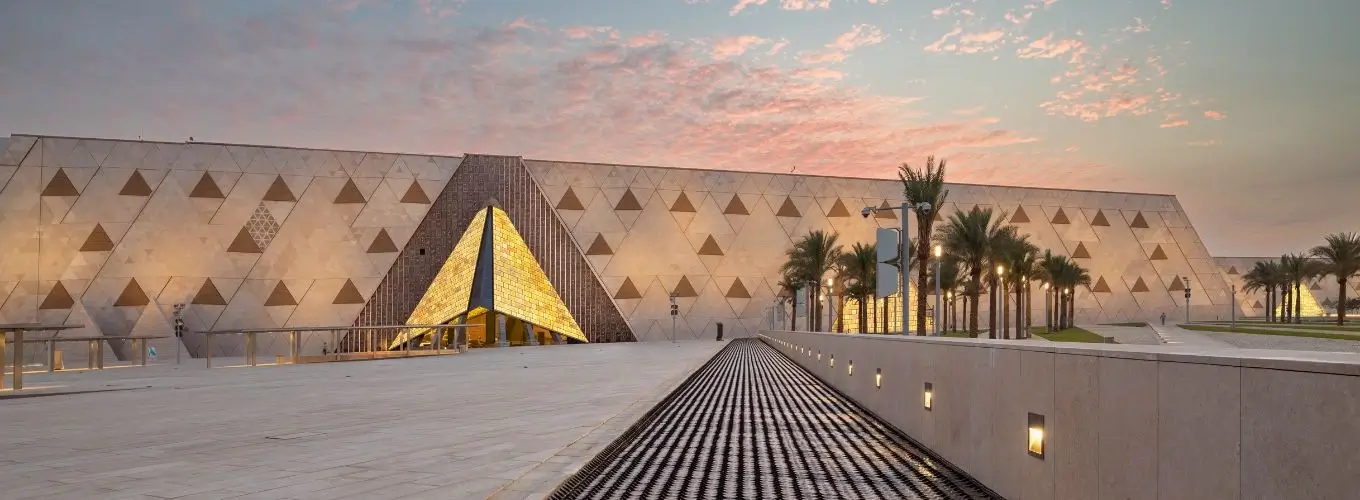
Yes — the Grand Egyptian Museum (GEM) is the world’s largest archaeological museum, opened in 2023 next to the Giza Pyramids. It houses over 100,000 Pharaonic artifacts including the complete treasures of Tutankhamun.
🏛️ World’s largest archaeological museum 480,000 m² next to the Pyramids of Giza; home to 100,000+ artifacts spanning Egypt’s entire ancient history in one building.
👑 Tutankhamun’s treasures are the star attraction all 5,000+ objects from his tomb displayed together for the first time ever, including the golden death mask & royal chariots.
🎟️ Tickets from 1,000 EGP for foreigners book online in advance via the GEM official site; entry includes the main galleries & Grand Staircase with 87 royal statues.
⏰ Allow 3–4 hours minimum open daily 9 AM–9 PM; combine with a Pyramids visit on the same day as both are a 5-minute drive apart on the Giza plateau.
The Grand Egyptian Museum is the largest archaeological museum in the world, built around a single civilization and housing over 100,000 artifacts on a site the size of 90 football pitches at the foot of the Giza Plateau. It opened in stages between 2023 and 2025, with the full Tutankhamun collection displayed together for the first time in its history. For most visitors, the GEM isn’t a standalone trip — it’s paired with the Pyramids on the same day, since the two sites sit less than two kilometers apart. Tripianto builds this pairing into most of our Cairo tours, with a private Egyptologist guide handling ticket logistics so you’re not queuing at the gate. Here’s everything you need before you go: prices, hours, booking steps, and what to actually see once you’re inside.
The Grand Egyptian Museum History
The idea for a museum on this scale dates back to the early 2000s, when Egypt’s Ministry of Antiquities decided the collection at the century-old Egyptian Museum in Tahrir Square had outgrown its building. An international design competition drew over 1,500 entries from 83 countries; the winning design, by Irish firm Heneghan Peng, positioned the museum on a direct sightline with the Great Pyramid, so the two structures appear to converge as you approach.
Construction began in 2005 and ran for two decades, delayed at points by the 2011 revolution, funding gaps, and the pandemic. The final structure covers roughly 480,000 square meters, making it the largest museum complex ever built for a single ancient culture. Its centerpiece is a 3,200-year-old, 11-meter, 83-ton statue of Ramses II, moved from Giza and installed as the first thing visitors see in the atrium.
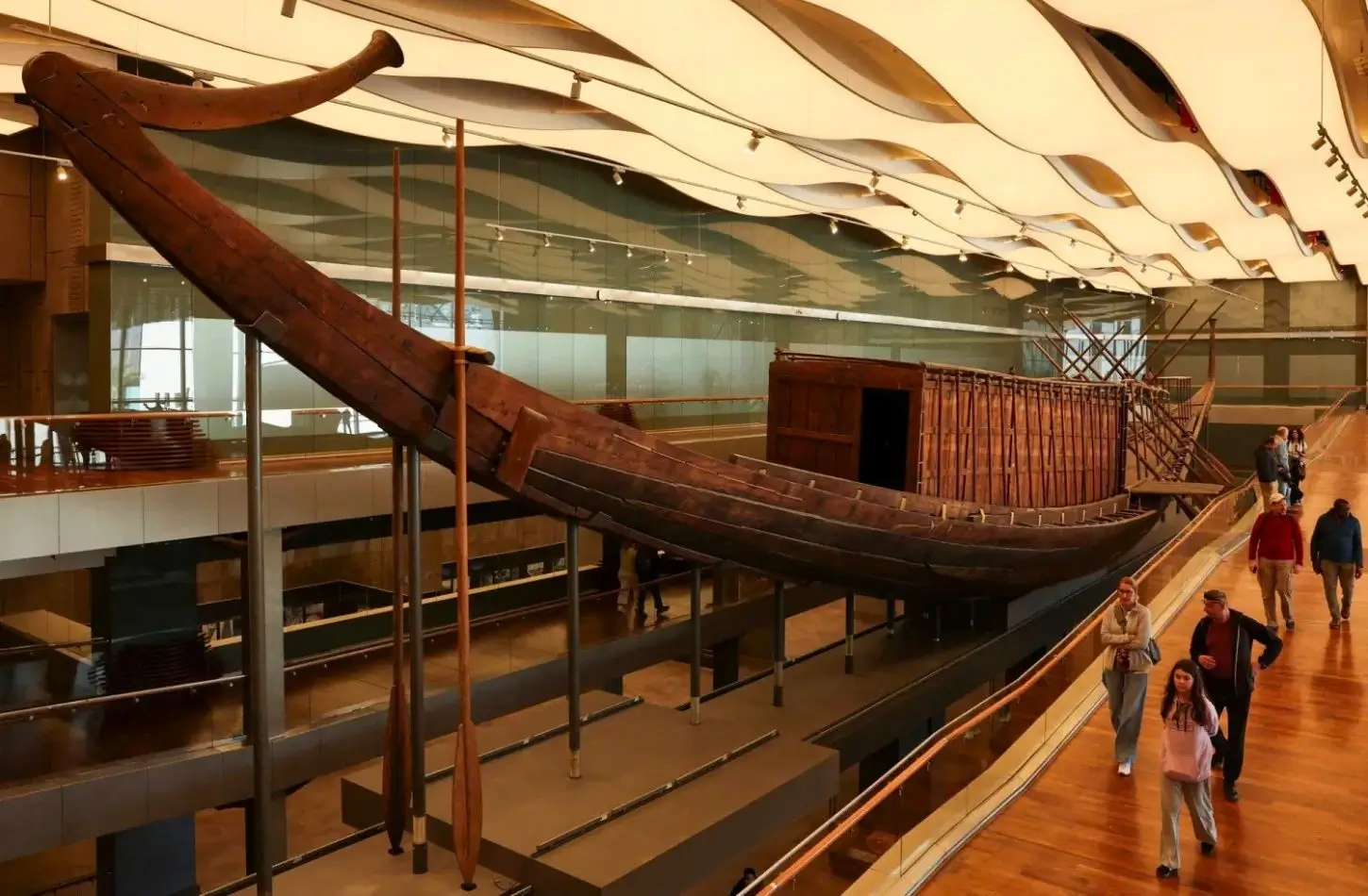
What makes the collection unlike any other Egypt museum is the Tutankhamun galleries: for the first time since the tomb’s discovery in 1922, all 5,000-plus objects from the boy king’s burial are displayed together in one place, rather than split across different institutions. The museum also houses the Khufu Solar Boat, a 4,600-year-old funerary vessel found buried beside the Great Pyramid, in its own purpose-built hall.
The Grand Egyptian Museum Opening
The museum’s opening was one of the most drawn-out in modern museum history, and it’s worth understanding the timeline because older articles online still describe a “soon to open” museum that has, in fact, been open for some time.
Partial areas — the Grand Staircase, the commercial zone, and a limited selection of galleries — opened to ticketed visitors starting in October 2024, while construction continued elsewhere on site. The full, official inauguration took place on November 1, 2025, with heads of state and a televised ceremony, after which every gallery, including the complete Tutankhamun collection, became accessible to the public. If you read a source describing GEM as “under construction” or “partially open,” it’s outdated — as of today, the entire museum is operating on regular visitor hours.
Grand Egyptian Museum Ticket Price
Ticket pricing uses a three-tier system: Egyptian nationals, foreign residents of Egypt, and international tourists, with the international rate covering the actual cost of preserving a collection of this size. As of mid-2026, the general admission rate for foreign adult visitors is roughly $30 USD (around 1,450–1,500 EGP), with a reduced rate of about half that for foreign students (aged 13–25 with valid ID) and children aged 6–12.
Egypt’s Ministry of Tourism and Antiquities has confirmed a price adjustment taking effect November 1, 2026, raising the foreign adult rate to $35 and the Egyptian resident rate slightly as well — so if you’re booking a trip for late 2026, budget for the new figure rather than the current one. If you’d rather skip the ticket portal entirely, a Day Tour to Grand Egyptian Museum bundles your admission, transfers, and a licensed Egyptologist guide into one booking.
General admission covers the main chronological galleries, the Grand Hall and Staircase, the Khufu Solar Boat hall, and the exterior gardens. The Tutankhamun galleries are included in standard admission on most days, though it’s worth confirming at the time of booking since GEM has occasionally run separate pricing structures for the collection during peak periods. Children under six enter free.
📌 A private guided visit through Tripianto includes your admission ticket pre-booked in your name, so you skip the online portal entirely — useful if you’re combining GEM with the Pyramids or Saqqara on a longer Egypt travel package.
Booking the Grand Egyptian Museum Tickets Online
On-site ticket sales have been discontinued. Booking the Grand Egyptian Museum tickets online, through the official portal, is now the only way to guarantee entry — walk-up visitors without a pre-booked slot are turned away once the daily quota is reached.
Here’s how the process works:
- Go to the official site. Tickets for the Grand Egyptian Museum are sold exclusively through the museum’s official ticketing portal. Third-party resellers frequently mark up prices with no guarantee your booking is valid.
- Choose your ticket type — general admission or a guided tour ticket.
- Select your visit date and a two-hour entry time slot. This slot controls when you enter, not how long you can stay.
- Choose your visitor category — Egyptian, Arab/foreign nationality, or expatriate resident (proof of residency required for the resident rate).
Enter contact details and pay online. You’ll receive an email confirmation with a QR-coded e-ticket — this is what you present at the gate, no printing required.
Book at least a few days ahead in peak season (October–April), and further out around public holidays, when the museum regularly hits its daily visitor cap. Tickets are non-transferable and non-refundable, so double-check your date before paying.
Grand Egyptian Museum Opening Hours
Grand Egyptian Museum opening hours currently run on a split schedule depending on the day of the week:
- Sunday, Monday, Tuesday, Thursday, Friday: Complex 8:30 AM–7:00 PM · Galleries 9:00 AM–6:00 PM
- Wednesday and Saturday (extended hours): Complex 8:30 AM–10:00 PM · Galleries 9:00 AM–9:00 PM
Last entry to the galleries is one hour before closing. If you want to see the Tutankhamun collection without a crowd, arrive right at opening — coach groups typically arrive from mid-morning onward. The Wednesday and Saturday evening slots are the best-kept secret for a quieter visit with better light for photos, since most day-trippers have already left by early evening.
Hours shift slightly during Ramadan, with later opening and earlier evening closing, so it’s worth confirming exact times if your visit falls during that period.
Grand Egyptian Museum Map: Finding Your Way Around
The Grand Egyptian Museum map is worth studying before you arrive, because the building is genuinely vast — visitors regularly underestimate how much walking is involved.
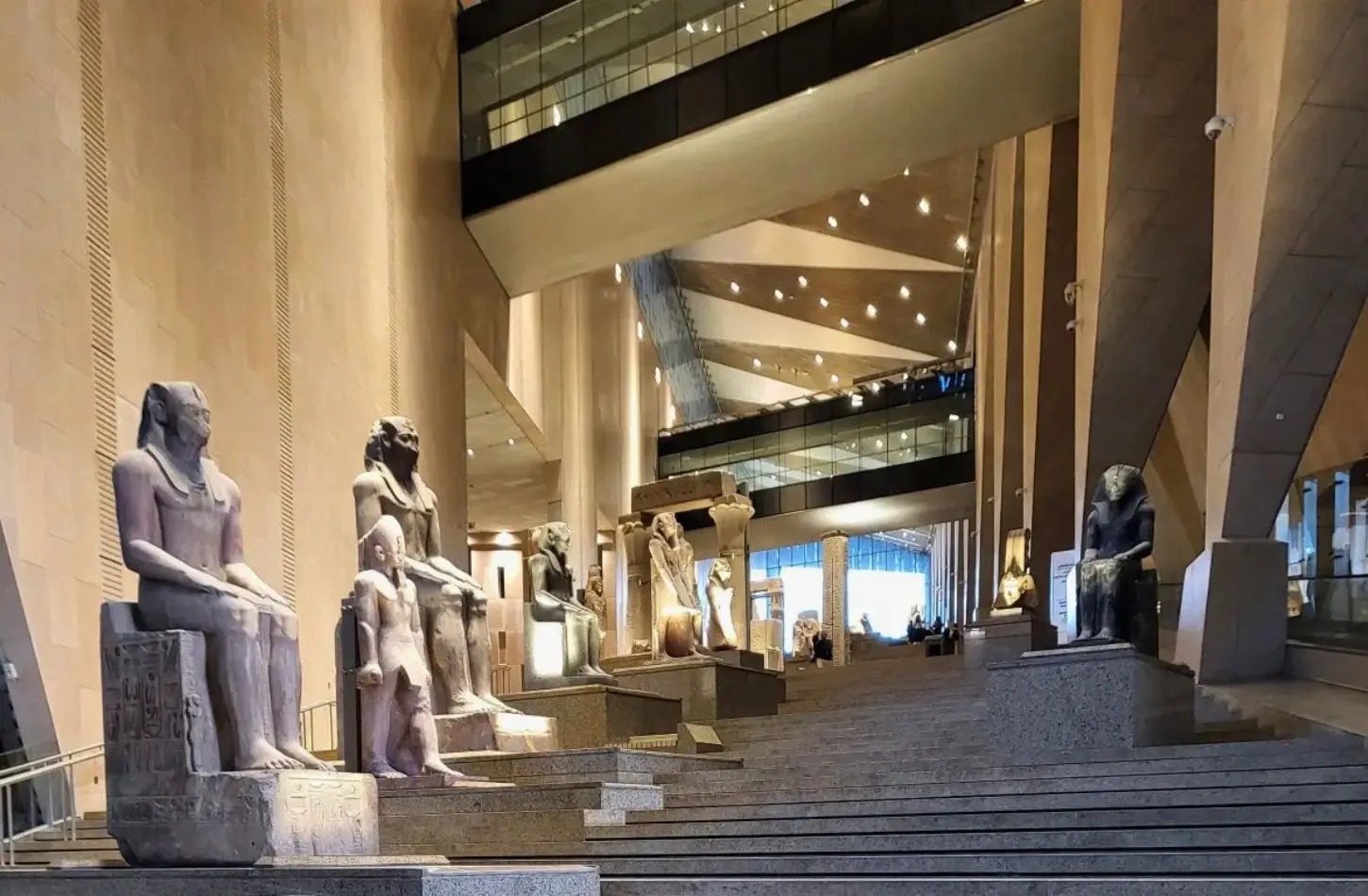
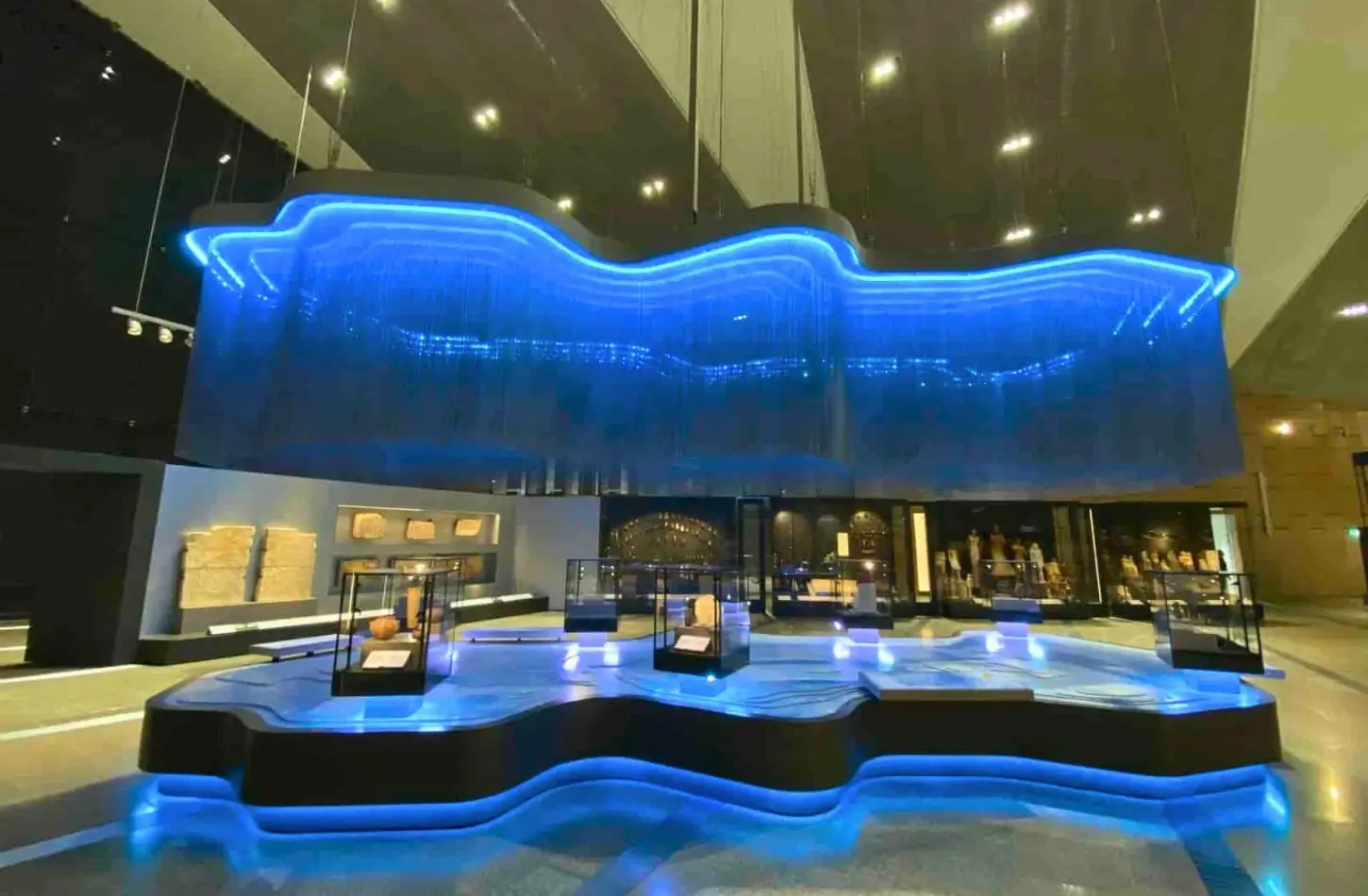
The layout leads visitors up a monumental Grand Staircase lined with over 80 statues arranged in rough chronological order from Old Kingdom to Greco-Roman Egypt, culminating in a panoramic window framing the Pyramids. From the top of the staircase, the main galleries branch off across two floors, organized by era rather than by object type — so ancient tools, jewelry, and sarcophagi from the same period sit together rather than being separated by category.
The Tutankhamun galleries occupy their own dedicated wing and are best tackled with 90 minutes to 2 hours to themselves. The Khufu Solar Boat has a separate building connected by a walkway, easy to miss if you’re rushing. Free museum maps are available at the entrance, and the official app includes an interactive floor plan if you’d rather navigate digitally.
Realistically, budget a minimum of 3 to 4 hours for a first visit, and closer to a full day if you want to read every panel and see both boats and the full Tutankhamun collection without rushing.
Grand Egyptian Museum Photos: What You’re Allowed to Capture
Personal photography and videography with phones and standard cameras are permitted throughout most of the museum, which is a departure from the strict no-photo rules at some other Egyptian sites. The exceptions are specific designated zones inside the Tutankhamun galleries, clearly signposted, where photography is restricted to protect the artifacts and manage crowd flow.
Flash photography, tripods, monopods, selfie sticks, and drones are not permitted anywhere on site. If you’re after the classic shot — the Ramses II colossus at the base of the Grand Staircase, or the Pyramids visible through the atrium’s glass wall — early morning light works best, before the hall fills with visitor groups.
Commercial photography or filming, including for advertising or documentary use, requires prior written approval from the museum and a separate fee — this applies even to professional-looking equipment used for personal content, so leave the gimbal and external lighting at home unless you’ve cleared it in advance.
What to See First — A Realistic Priority List
With over 100,000 artifacts on display, no visitor sees everything in one trip. If your time is limited, prioritize in this order:
- The Grand Staircase — the museum’s spine, and the fastest way to get a sense of scale.
- The Tutankhamun Galleries — allow the most time here; this is the collection people fly across the world to see.
- The Khufu Solar Boat — a genuinely unique object, 4,600 years old and remarkably intact.
- The Colossal Statue of Ramses II — take the photo everyone takes, then look up; the hall’s design deliberately frames it.
- The panoramic terrace — a direct view of the Giza Pyramids from inside the museum, one of the few places in the world where you can see an ancient wonder and a modern one in the same frame.
If your trip includes the Pyramids, pairing the two makes practical sense: the history of the Pyramids of Giza directly informs several galleries here, since many objects in GEM’s earlier collections were excavated from the Giza Plateau itself.
Tips for Visiting the Grand Egyptian Museum
A few things that make a real difference on the day, based on how the site actually runs rather than the official brochure:
- Book your entry time slot for the first or last hour of the day. The 9–10 AM and 5 PM+ slots are consistently the quietest, especially in the Tutankhamun wing.
- Wear real walking shoes. Between the staircase, the two-floor galleries, and the walkway to the Solar Boat hall, you’ll cover several kilometers on foot.
- Bring a small water bottle. Food and drink aren’t allowed inside galleries, but small water bottles are permitted, and there’s no air conditioning shortage — the heat is outside, not in.
- Store large bags before you enter. Anything over 40×40cm needs to go into the cloakroom; don’t bring a full daypack if you can avoid it.
- Pair it with the Pyramids, not with Cairo’s Egyptian Museum, on the same day. GEM and the Pyramids are a 20-minute drive apart; Tahrir Square is a 45-minute drive in traffic. Trying to fit all three into one day usually means rushing all three.
- If you’re short on time, prioritize a guided visit. A licensed Egyptologist can walk you straight to the highlights in the right order, which matters more here than at almost any other Egypt site given the sheer number of objects on display.
FAQS about Grand Egyptian Museum
Is the Grand Egyptian Museum fully open to the public?
Yes. Following its official grand opening in late 2025, the Grand Egyptian Museum (GEM) is now fully operational in 2026. All main exhibition halls, the Grand Staircase, the commercial areas, the newly inaugurated Egyptian-French research library, and the highly anticipated complete King Tutankhamun collection are open to international and local visitors.
How much is the ticket for the Grand Egyptian Museum?
Ticket prices for international adult visitors are EGP 1,450 (approximately $30 USD). Foreign students (with a valid ID) and children aged 6 to 12 can purchase discounted tickets for EGP 730. Entry is free for children under the age of 6.
Can you buy tickets on-site at the Grand Egyptian Museum?
No, tickets are no longer sold on-site at the venue. All visitors must reserve a timed-entry slot and purchase their tickets in advance online via the official portal (visit-gem.com). It is highly recommended to book a few days in advance to secure your preferred time block and protect against fraudulent third-party ticketing sites.
Where is King Tutankhamun’s gold mask: the Grand Egyptian Museum or Tahrir Square?
King Tutankhamun’s complete tomb collection—comprising more than 5,000 artifacts—has been fully consolidated at the Grand Egyptian Museum (GEM) in Giza. This marks the first time in history that the entire collection, including the iconic gold mask and coffins, has been displayed together in a single state-of-the-art exhibition space.
How long does it take to tour the Grand Egyptian Museum?
Visitors should plan to spend at least 3 to 4 hours to explore the main galleries, the Grand Hall, and the immediate outdoor complex. Because the GEM spans over 500,000 square meters and holds over 100,000 artifacts, history enthusiasts and those booking comprehensive guided tours may easily spend 5 to 6 hours on-site.
How far is the Grand Egyptian Museum from the Giza Pyramids?
The Grand Egyptian Museum is located just 2 kilometers (about 1.2 miles) away from the Giza Plateau. It is strategically positioned right next to the Pyramids, making it incredibly easy for travelers to tour both world-class landmarks on the exact same day.
conclusion
The Grand Egyptian Museum earns its reputation as one of the most significant cultural openings of the decade — not just for its scale, but because it finally reunites Tutankhamun’s treasures in one place, a century after they were found. Book your entry slot in advance, arrive early, and pair the visit with the Pyramids for one seamless day rather than a rushed afternoon. Tripianto builds this exact pairing into our private Cairo tours, with a licensed Egyptologist and pre-booked tickets so you spend your time inside the galleries, not in a queue.
