


Last verified: June 2026
Quick Answer
🏛️ How did ancient Egyptians build the Pyramids?
Using 2.3 million stone blocks, copper tools, water-lubricated sledges, and ramp systems — built by paid skilled workers (not slaves) over ~20 years, around 2550 BCE.
Quarrying
Copper chisels for soft limestone · Dolerite hammers for hard Aswan granite
Lifting
Ramps — small inclined ramps + levering at upper levels (not one giant ramp)
Materials
Local limestone for core · Tura limestone for outer casing · Aswan granite for burial chambers
Mortar
Gypsum and rubble mortar to stabilize and fill gaps between core blocks
How ancient Egyptians built the Pyramids has fascinated historians, engineers, and travelers for centuries — and archaeology now gives us clearer answers than ever before. Around 4,500 years ago, a workforce of skilled laborers quarried 2.3 million stone blocks, transported them across the Nile, and raised the Great Pyramid of Khufu to a height of 481 feet using ramps, sleds, copper tools, and an extraordinary logistical system. Modern discoveries — from Merer’s papyrus diary to muography scans revealing hidden chambers — continue to reshape what we know. This guide covers the methods, materials, workforce, and latest science behind one of history’s greatest engineering achievements.
Key Takeaways
- You will view these pyramids as engineering projects, with clear evidence and points for debate.
- The Giza site functioned as an integrated construction landscape.
- Archaeological finds point to skilled labor and strong organization.
- Core materials and transport methods are central to the story.
- >Modern imaging and Merer’s diary continue to unlock new secrets.
What You’ll Learn in This How-To Exploration of Pyramid Construction
Here you will find a concise roadmap that turns big theories about construction into testable field tasks. The section breaks methods into clear phases so you can see what each crew did and when.
How this guide breaks down methods, materials, and systems
Phase-based view: You’ll follow sourcing, transport, ramp choices, leveraging, and final placement. Each phase shows the roles of a skilled team and the timing that kept work moving.
Ramps versus levering: Egyptologist research agrees that ramps were central, but they were often paired with levering. Archaeology favors small ramps, inclined causeways, and staged ramps over a single giant ramp.
Evidence-driven tests: You’ll compare competing ramp systems using tool marks, settlement traces, and experiments that measure effort, gradient, and safety.
Logistics and time: Learn why sequencing mattered, how provisioning and tool upkeep shaped output, and what archaeologists look for when they reconstruct a workflow.
- Stepwise phases to make theories tangible.
- Evidence supporting the ramp system and levering at upper levels.
- Practical checks you can use to evaluate new claims.
Why Did Ancient Egyptians Build the Pyramids?
Before understanding how the pyramids were built, it helps to understand why. Ancient Egyptians constructed pyramids as royal tombs designed to protect the pharaoh’s body and spirit for eternity. Egyptian religion taught that a pharaoh’s ka — the life force — remained with the body after death and required a permanent, secure resting place to complete the journey to the afterlife. The pyramid form itself carried religious meaning: its shape represented the primordial mound from which the sun god Ra was said to have risen, and its smooth sides may have symbolized rays of sunlight descending from the sky, connecting the pharaoh to the gods.
The pyramid building peaked during the Old Kingdom (c. 2686–2181 BCE), a period of extraordinary royal power and economic organization. Khufu, Khafre, and Menkaure each required a monument that would outlast civilization itself — and on the Giza Plateau, they achieved exactly that.
📌Ahmed Emam’s Tip: When you visit the Giza Plateau, notice that the three pyramids align with the stars of Orion’s Belt — a deliberate astronomical orientation that reflects the ancient Egyptians’ belief in the pharaoh’s celestial destiny.
Setting the Stage: Timeline, Scale, and Purpose in the Old Kingdom
Around 4,500 years ago, rulers set a dramatic program of royal monuments on the Giza Plateau. You will place these works in the Old Kingdom context, where pharaohs funded long-term projects to secure their burial and cosmic role.
From Khufu to Menkaure: 4,500 years ago at the Giza Plateau
Khufu’s project began circa 2550 BCE. The great pyramid giza rose in planned stages and anchored a larger funerary complex. Khafre followed with a related complex, which includes the Great Sphinx. Menkaure finished a smaller set with two temples and three queen pyramids.
📌Ahmed’s tip: When you stand at the base of the Great Pyramid for the first time, look down — not up. The base stones are so precisely leveled that you can barely slide a piece of paper between them. I’ve been guiding visitors at Giza for over a decade, and that detail still stops people in their tracks. No modern laser could have done it better
Scale of the Great Pyramid: estimated 2.3 million stone blocks and up to 481 feet
The Great Pyramid reached about 481 feet and used roughly 2.3 million stone blocks. Those stones and blocks demanded years of coordinated supply, labor, and craft. You will see that each pyramid complex combined temples, causeways, and support structures to serve ritual and administration.
Who Built the Pyramids? Workers, Not Slaves
One of the most persistent myths about pyramid construction is that enslaved people built them under brutal conditions. Archaeological evidence tells a completely different story. Excavations at Giza by Egyptologist Mark Lehner and Zahi Hawass uncovered a workers’ village complete with bakeries, breweries, medical facilities, and burial plots — the infrastructure of a respected, organized workforce, not a slave camp.
Estimates put the core skilled workforce at around 20,000 to 30,000 people, supplemented by rotating teams of laborers during the Nile flood season when agricultural work paused. Workers were paid in food rations — bread, beer, meat, and fish — and received medical care. Graffiti found inside the pyramids shows crew names like “Friends of Khufu” and “Drunkards of Menkaure,” suggesting a sense of identity and even pride in the work.
Merer’s diary — a papyrus logbook discovered at Wadi el-Jarf in 2013 — provides the most direct written evidence, documenting daily deliveries of Tura limestone by boat to the Giza site and the administrative systems that kept construction on schedule.
How Ancient Egyptians Built the Pyramids
You’ll examine clear archaeological markers that separate proven methods from speculative ideas. Start with visible tool marks, quarry faces, and dolerite impacts that indicate quarrying with copper chisels and pounding on hard stone. These traces form a factual backbone.
Separating scientific facts from controversial hypotheses
Facts include copper chisel impressions on softer limestone, dolerite hammer use on granite, and field evidence that ramps served as lifting aids. Experiments and material analysis let archaeologists test these claims rather than rely on narrative alone.
Why have techniques evolved across time
Over centuries, techniques shifted. Early projects favored all-stone cores. Later, Middle Kingdom work often used mud-brick cores with limestone veneer to save labor and stone. That change shows practical trade-offs in resources, speed, and safety.
As you read on, treat ramps and levering as complementary solutions. You will trace a clear workflow: quarry, move, lift, place, and finish—grounded in field evidence and open to debate where proof is thin.
From Quarry to Site: Materials and Stone Sourcing
Trace the path that quarried rock took from source to finished course at Giza. You will learn which materials served structural roles and why those choices mattered for durability and load. This section links source, tool, and transport decisions.
Local limestone, Tura casing, and Aswan granite
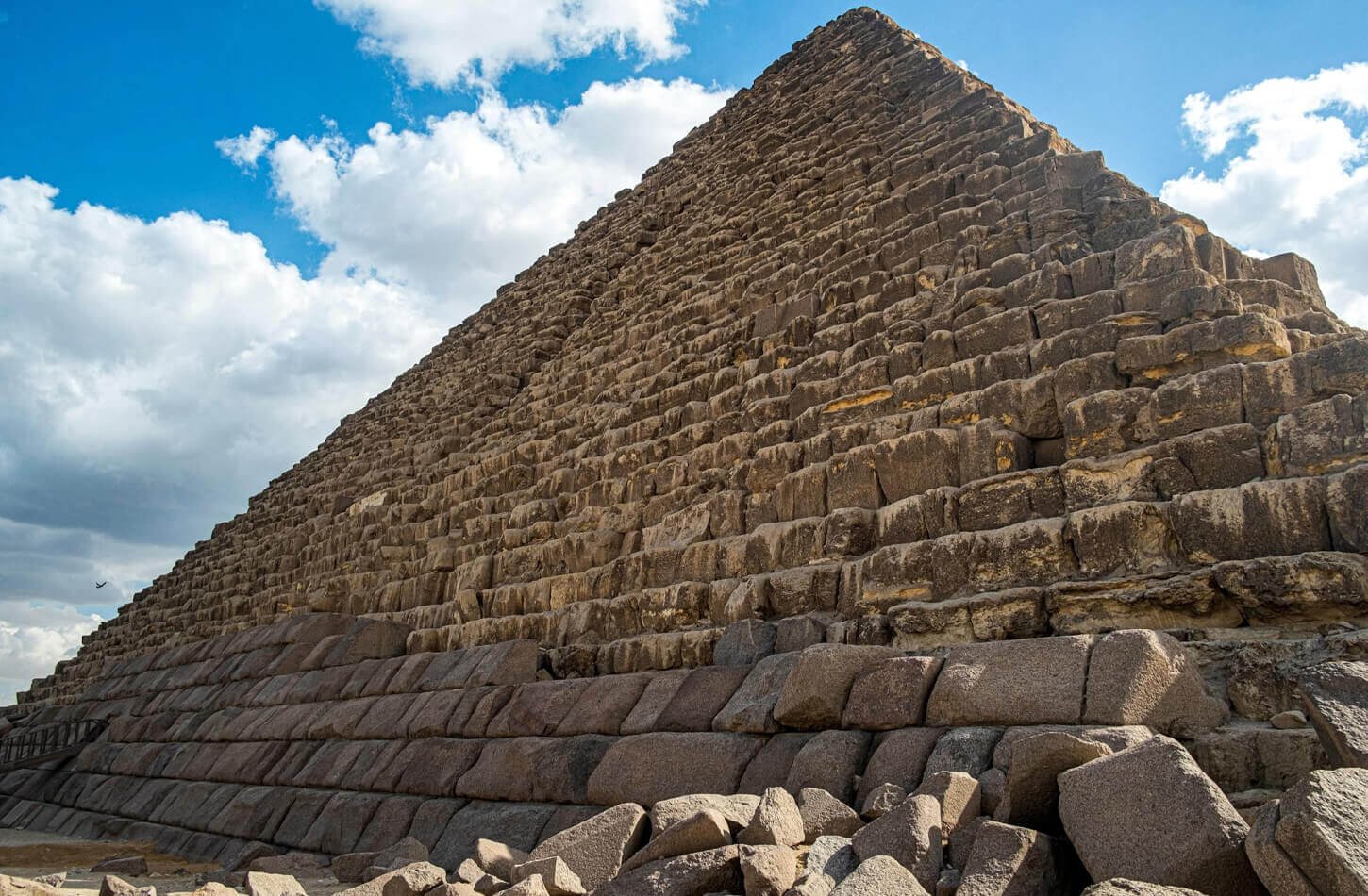
Local limestone supplied core courses, while bright Tura limestone formed the outer casing. Aswan granite appears in high-stress features like burial roofs and portcullises. These choices balanced availability with mechanical needs.
Tools matched to the material
Soft blocks were shaped with copper chisels. Harder rock required dolerite pounding and sand abrasion. Tool marks on quarry faces show regular maintenance cycles and resharpening tasks that kept crews productive.
📌Ahmed’s tip: If you visit the pyramid complex, look closely at the base courses — you can still see the rough local limestone used for the core, compared to the smoother Tura casing stones that survive on Khafre’s pyramid near the apex. That contrast tells the whole material story at a glance. I always point this out to guests on our Cairo Giza tours
Mortar, gaps, and handling heavy elements
Gypsum and rubble mortar filled the gaps behind the fine walls, stabilizing the rough core geometry. Some elements weighed many tons and demanded staging and trimming near both quarries and the site. Procurement schedules had to feed crews fast enough to place nearly a million stone blocks in sequence.

Moving Millions of Pounds: Sleds, Rollers, and River Logistics
This section tracks how massive stones were moved from the river landing to the ramp, and what experiments reveal about force and timing. You will see practical choices that made a long project deliver thousands of courses over the years.
Sled transport with water lubrication
Tomb art shows 172 men pulling a 60-ton statue on a sled, a dramatic record of raw muscle and coordination. Experiments confirm that wetting packed sand sharply reduces friction, allowing fewer people to move heavier loads with predictable effort.
📌Ahmed’s tip: The ancient boat pits beside the Great Pyramid are one of the most under-visited spots at Giza. The Solar Boat Museum houses a 43-metre cedar barge reassembled from 1,224 pieces — the same type of vessel Merer’s diary describes carrying limestone blocks to the site. Most visitors walk straight past it. Don’t.
Rollers, cradles, and alternate methods
For certain sizes, cradle rollers can outperform flat sled runners. Round supports suit long, narrow stones, while sleds are best for irregular blocks. You’ll size crews by weight: small teams for 2–3 ton blocks, larger crews for bulk lifts.
River runs and Merer’s diary
Merer’s logbook documents ferrying Tura limestone by boat to Giza, proving a river leg in the supply system. That handoff defines timing: boats, shore crews, sledding lanes, and ramp managers must sync to avoid delays.
Performance, pacing, and practical rules
Field trials show an 18-man crew moved a 2.5-ton block up a 1-in-4 incline at roughly 18 meters per minute. Use that as a baseline for minutes per meter, rest rotations, staging lanes, and regular track wetting to prevent rutting.
Your checklist: size crews by weight class, wet and resurface trackways, plan ramp entries, document pulls and slippage, and keep contingency gear for oversized or fragile stone blocks.
Ramps in Practice: Designing, Building, and Using Ramp Systems
We contrast ramp shapes and operations to determine which best fits the site evidence. You’ll learn why a single, massive approach often fails at scale and in logistics. Instead, small working ramps and staged passages fit available traces and crew needs.
Straight, zig-zag, spiraling, and internal options
Straight ramps need huge footprints and rare support proofs. Zig-zag layouts save space and ease gradients. Spirals or internal routes reduce exposure and let crews work closer to the face.
Archaeological evidence versus the missing mega-ramp
Archaeologists find berms, inclined causeways, and short ramps at Giza. That contrasts with the absent signs of any old ramp large enough to match a full face. Evidence favors phased, smaller solutions.
Combining ramps with levering and managing tight spaces
Use a ramp system to bring stone and blocks to staging platforms. Then switch to levering for upper courses and final placement near the apex. Keep gradients near 10% for safe traction.
Practical measures for traffic, reinforcement, and accuracy
Design turnarounds and passing bays so moving sleds do not block returns. Revet ramp edges with cribbing and stone to prevent slumps. Place surveying checkpoints along routes to keep angles and corner lines within tolerance.
Key takeaway: plan modular ramps, pair them with levering for top work, and schedule frequent adjustments as the pyramid rises to keep flows steady and safe.
How Long Did It Take to Build the Great Pyramid?
The Great Pyramid of Khufu is estimated to have taken approximately 20 years to complete, based on both the ancient historian Herodotus and modern archaeological analysis. To meet that timeline, workers would have needed to place one 2.5–15 tonne stone block every three minutes during active construction periods — a staggering rate that required flawless logistics across quarrying, transport, lifting, and placement.
A 2025 mathematical study published in Nature proposed a new answer to how this pace was possible: four spiraling ramps — beginning at different points around the pyramid’s base and winding upward simultaneously — would have allowed multiple crews to work in parallel, completing the structure within Khufu’s 27-year reign. Previous single-ramp models couldn’t account for the speed.
The sheer precision of the finished structure adds another layer of mystery. The base is level to within 2.1 centimeters across its entire 230-meter span, and the four sides are aligned with the cardinal points to within 0.05 degrees — achieved without modern surveying equipment.
Levering and Placement: Fine-Tuning Each Course
This part reviews tested lift methods and timing cues that help crews place heavy units without risking finished surfaces. You will see when teams used slow, incremental shimming and when they used single-lift devices for fast, safe moves.
Incremental shimming versus single-lift devices
Isler’s trials show incremental shimming raised a course in about 1.5 hours. Keable’s variant sped small lifts to roughly two minutes by using pallets and small blocks. Hussey-Pailos proved a single-lift lever device could raise a 1,100 kg unit in under a minute with a safety factor of two.
Choose among methods based on block weight, crew skill, and available lever materials. For very heavy stones, staged shims protect finished faces and walls. For smaller units, single-lift devices cut time and crew fatigue.
Trials, timing, and job-site routines
Use trial benchmarks to plan lifts per hour and crew rotations. Design cribbing and shims so that levers get a secure bite on the stone without nicking the fine work. Set staging ledges at the final lift locations to avoid congestion at ramp entries.
Practical rules: standardize lever lengths and shim sizes, run inspection checks after each placement, log lift metrics, and train crews in clear sequencing to avoid pinch zones. This system keeps course lines square and lets a pyramid rise with predictable daily progress.
Nile Waterways and the Ahramat Branch: The Arteries of Construction
A recent 2024 study mapped the vanished Ahramat Branch, a roughly 0.5-km-wide channel at least 25 m deep that once ran close to many work fronts. That waterway provided a direct route for boats carrying heavy loads toward the Giza plateau and nearby quays.
Using a now-extinct Nile branch to reach nearby workfronts
You’ll route large cargo through this linked river network to shorten land hauls. Merer’s diary supports the view that the Tura limestone was transported by boat to Giza, linking written records to the mapped channel.
Boats, barges, and suggested hydraulic ideas
Plan barge drafts and capacities to suit multi-ton stone and blocks, then time deliveries for stable river levels. Some scholars propose locks, but there is no clear on-site evidence for hydraulic lifts, so treat that idea cautiously.
Practical point: Use embankments, temporary canals, and synchronized offloading teams so stone arrives at the right course on schedule. By linking upstream quarries with staging yards at the Pyramid of Giza site, waterways turned a regional supply chain into a reliable artery for the world’s major monuments.
Organizing the Workforce and Building the Complex
Coordinating specialists, food, and river traffic created a dependable workflow for massive stone projects. ,
Skilled teams, worker villages, rations, and a national project
You’ll structure work into rotating crews with clear roles: quarrying, hauling, ramp crews, lever teams, and finishers. Team leaders oversaw safety, tool upkeep, and quality control.
Excavations uncovered a 17-acre workers’ city with bakeries and animal bones. That evidence shows well-fed, skilled laborers—not slaves—and supports a national mobilization that drew people from many regions.
You’ll plan seasonal labor flows, training cycles, and copper tool resharpening to keep crews productive throughout long campaigns.
📌Ahmed’s tip: The workers’ village site is rarely on standard tourist itineraries, but it is one of the most powerful places at Giza. Standing where the bakers, doctors, and stonemasons lived 4,500 years ago completely changes how you see the pyramids above. On our private tours, we include a stop there specifically — ask for it when you book.
Beyond the pyramid: temples, causeways, boat pits, and the Great Sphinx
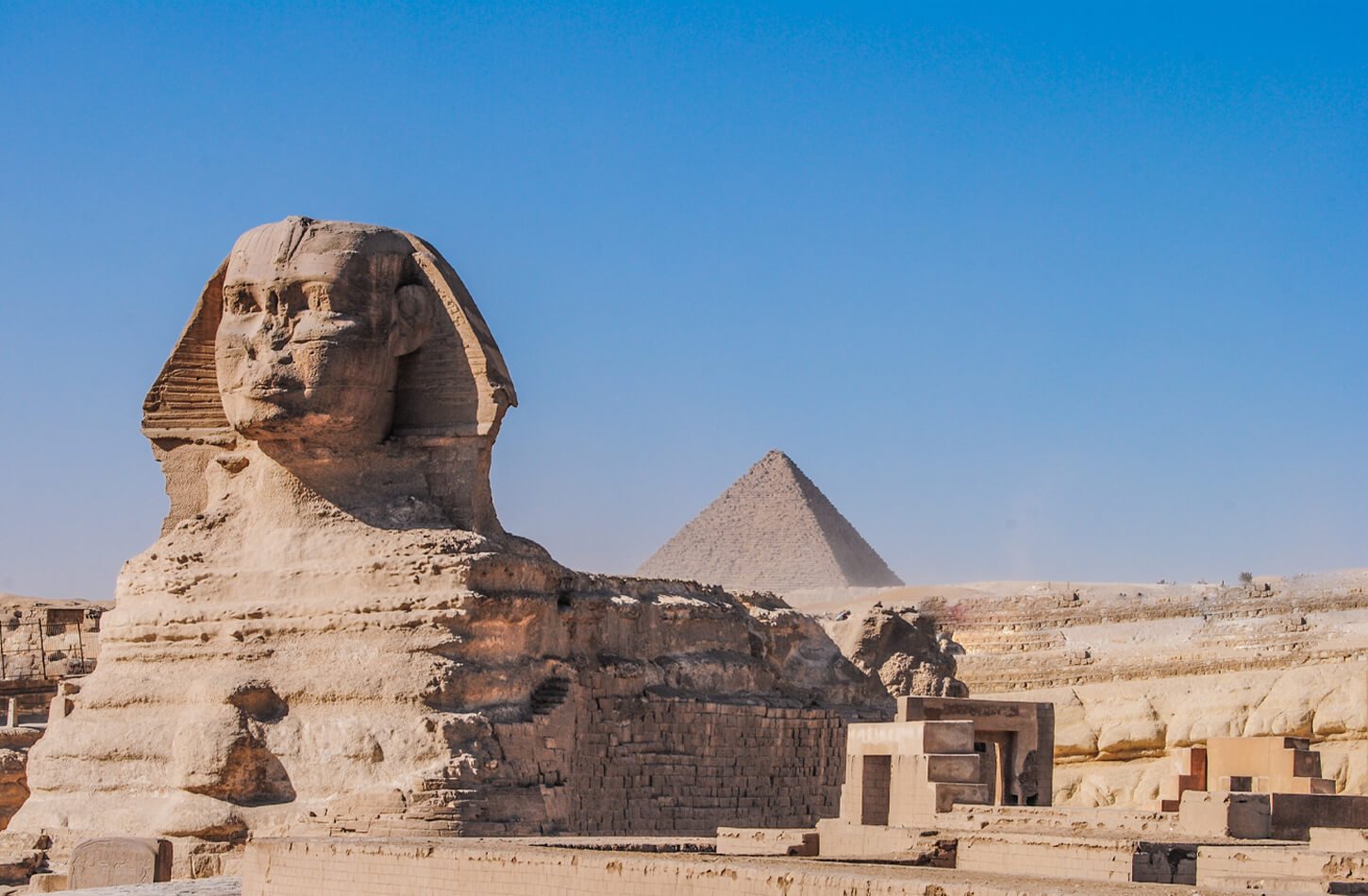
Each royal complex included temples, causeways, and boat pits; Khafre’s layout links the Great Sphinx to ritual and logistics. You’ll schedule these works alongside the central pyramid so that burial needs meet architectural milestones.
State logistics tied farms, workshops, and river fleets to daily outputs. Coordinate stone intake with interior chamber work, and maintain clear lines of communication from the waterfront to the ramps to the apex. This keeps every crew synchronized and progress predictable.
What Research Says Today: Scans, Debates, and Enduring Mysteries
Today, new imaging and landscape studies give you sharper views of internal space and supply routes. Muon-based scans by Scan Pyramids revealed large voids inside the Great Pyramid that match or exceed the size of the Grand Gallery and the North Face Corridor.
Cosmic-ray scans and hidden voids
Cosmic-ray muography peeks through tons of rock and shows cavities that may relate to engineering. Some scholars argue that these areas served as stress relief or temporary corridors for moving heavy stone.
That idea links to on-site logistics and the mapped Ahramat Branch, plus Merer’s diary, which together make river transport and staging plausible for an estimated 2.3 million blocks and millions of tons moved over the years.
Why do some methods remain debated
Specialists accept ramps and levering as part of a system, but the old ramp mega-slope lacks supporting traces and is widely rejected. Archaeologists weigh scans, material study, and comparative builds to test rival models.
Some secrets will remain, yet current research gives you a rigorous, evidence-based picture that narrows what a skilled team likely did at the Great Pyramid of Egypt and across the pyramids giza in the Old Kingdom.
📌Ahmed’s tip: The ScanPyramids project found a hidden corridor above the main entrance of the Great Pyramid in 2023 — about 9 metres long and pointing toward the burial chamber. Nobody has entered it yet. I remind visitors of this on every tour: we are still discovering new things inside a structure built 4,500 years ago. That is what makes Giza unlike anywhere else on earth.
Were the Pyramids Built by Slaves?
One of the most persistent myths surrounding pyramid construction is that enslaved people built these monuments under brutal conditions. Archaeological evidence gathered over the past four decades tells a fundamentally different story — and it is one of the most important corrections modern Egyptology has made to popular history.
What the archaeological evidence shows
Excavations at Giza, led by Egyptologist Mark Lehner and his team, uncovered a workers’ settlement covering roughly 17 acres directly south of the Sphinx. The site contained industrial bakeries capable of producing thousands of loaves daily, breweries, copper tool workshops, and a medical facility with skeletal evidence of successful bone surgery and amputations — procedures that require skilled practitioners and post-operative care. Workers were buried in tombs near the pyramids themselves, some with grave goods, a mark of social respect, impossible to reconcile with enslaved status.
📌Ahmed’s tip: At the workers’ cemetery near the pyramids, you can see small mud-brick tombs built for the labourers — modest compared to the pharaohs’ monuments above, but real tombs nonetheless, with offerings placed inside. Slaves were not buried like this in ancient Egypt. Every time I show this to visitors, the reaction is the same: genuine surprise. It is the most convincing argument against the slave myth you will ever see.
Who actually built the pyramids?
The builders were skilled Egyptian citizens organized into permanent crews of roughly 2,000 men, subdivided into rotating gangs with names inscribed on the pyramid stones themselves — titles such as “Friends of Khufu” and “Drunkards of Menkaure.” These crews received regular rations of bread, beer, beef, and fish, along with clothing and medical care. During flood season, when agricultural work was impossible, farmers from across Egypt contributed labor as a form of tax obligation — a practice known as corvée labor — working alongside permanent, highly skilled craftsmen year-round. Far from being forced into servitude, these workers appear to have held their role in considerable esteem.
Where the slave myth came from
The origin of the slave narrative traces almost entirely to the Greek historian Herodotus, who visited Egypt around 450 BCE — more than 2,000 years after the Great Pyramid was completed. Writing from second-hand accounts, he described 100,000 enslaved workers toiling in three-month shifts. No physical evidence at Giza supports that figure or that interpretation. Later, the association between Egypt and slavery was reinforced through religious texts and popular culture, cementing a misconception that modern archaeology has thoroughly dismantled. Today, Egyptologists are in broad consensus: the pyramids were built by a paid, organized, and respected Egyptian workforce — one of the most sophisticated labor mobilizations in the ancient world.
⭐If you want to walk the ground where these workers lived and worked, our Cairo tours include expert-guided visits to the Giza Plateau with full historical context — including the workers’ village site discovered by Lehner’s team.
Can You See How the Pyramids Were Built When You Visit Giza?
Visiting the Giza Plateau in person brings the engineering story to life in ways no article can fully capture. You can stand at the base of the Great Pyramid and look up at the core limestone blocks — still rough-hewn and visible where the polished Tura casing was stripped away in medieval times. The scale becomes real immediately: each course of blocks is roughly the height of a person.
Cairo day tours to the Pyramids typically include guided commentary at the site, and expert-led tours with a licensed Egyptologist go further — pointing out tool marks on exposed stone, explaining the logistics of the ancient harbor site discovered nearby, and showing you exactly where Merer’s supply boats would have unloaded Tura limestone. If the pyramids are what drew you to Egypt, booking a Cairo tour with an Egyptologist guide is the highest-value upgrade you can make to your itinerary. For those who want to pair Giza with Luxor and Aswan, an Egypt classic tour package covers all three regions in one trip.
Frequently asked questions
How did ancient Egyptians cut and move the massive pyramid stones?
Workers cut limestone using copper chisels and dolerite pounding stones. To move the blocks, they loaded them onto wooden sleds and dragged them across tracks wetted with water — experiments confirm this technique dramatically reduces friction. Tomb art from the period shows 172 men hauling a 60-tonne statue this way. Blocks were then transported by boat along the Nile and up ramps to their position on the pyramid.
Were the Egyptian pyramids built by slaves?
No. Archaeological evidence shows the pyramids were built by a paid, organized workforce of skilled laborers, not enslaved people. Excavations at Giza uncovered a workers’ village with bakeries, breweries, and medical care. Workers received food rations, including bread, beer, and meat, and the crew names found inside the pyramids suggest pride and camaraderie among the builders.
How long did it take to build the Great Pyramid of Giza?
The Great Pyramid is estimated to have taken around 20 years to build. To complete it within that timeframe, workers had to place roughly one stone block every three minutes during active construction. A 2025 study in Nature suggested four simultaneous spiraling ramps made this pace achievable by allowing multiple crews to work in parallel around the pyramid.
What tools did ancient Egyptians use to build the pyramids?
For soft limestone, workers used copper chisels and wooden mallets. For hard granite (used in burial chambers and portcullises), they used dolerite pounding stones and sand abrasion. Sleds, wooden rollers, levers, and water-lubricated ramps were the primary tools for moving and lifting. No metal pulleys or wheeled carts have been found at construction sites.
What is Merer’s diary, and what does it tell us about pyramid construction?
Merer’s diary is a papyrus logbook discovered at Wadi el-Jarf in 2013 — the oldest known papyrus in the world. Written by an inspector named Merer, it records daily deliveries of Tura limestone by boat to the Giza construction site circa 2560 BCE. It provides direct written evidence of the supply chain, workforce organization, and river logistics that powered pyramid building, and confirms the Nile played a central role in transporting materials.
Conclusion
This conclusion ties river logistics, craft, and field tests into a clear picture of major work at Giza.Practical planning and steady teams made daily progress possible over many years. You can now picture how Egyptian pyramids were built through a series of repeatable steps from the quarry face to the apex. Ramps, sleds, boats, and levering formed a coherent workflow that moved heavy blocks with care and accuracy.
Giza complexes paired temples, causeways, boat pits, and the great sphinx with a central Egyptian great pyramid. Modern scans and Ahramat Branch mapping add context while honest gaps remain, inviting future tests. Keep this practical model in mind when you judge new claims. Look for evidence, repeatability, and fit with known logistics before accepting bold revisions to how pyramids were built.
